Submit photo to: Conservation.Strategy@ODFW.state.gov
The shell of P. archimedis is broad- to narrow-conic and medium-large size for the genus (2.48-7.16 mm tall) with 4.0-5.75 whorls. The protoconch has 1.25-1.3 whorls, about 430 mm in diameter, and is smooth to weakly wrinkled at apex. The teleconch whorls are slightly to moderately convex and usually evenly rounded, but sometimes wider above. The aperture is ovate and angled above. The operculum is amber colored and broadly ovate, with a slightly eccentric nucleus and a dorsal surface that is weakly frilled. The attachment scar margin is slightly thickened near the nucleus, and the inner side sometimes has a narrow rim along outer edge. The animal is darkly pigmented with a dark brown snout. It has light to medium brown cephalic tentacles that sometimes have a narrow, pale central zone.
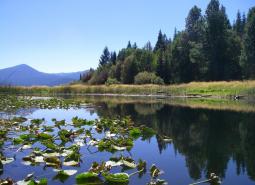
In Oregon, Archimedes springsnails occur at spring-influenced sites within nearshore habitat in the Upper Klamath Lake drainage. In lake habitats, P. archimedis prefers sites with gravel-boulder basalt and pumice substrates, and few macrophytes, but also occurs on mud substrate.
Limiting factors
Main threats to this species include altered groundwater quantity by irrigation projects and oversubscribed water usage, pollution of surface and groundwater by contaminants, and nutrient-enhancement from agriculture. Sedimentation and nutrient inputs from dredging, mining, road construction, and other land use practices may smother substrates or reduce egg survival. P. archimedis depends on stable water chemistry and flows characteristic of spring sources, therefore, activities that lower the water table and dry out habitat, such as water diversion for domestic, industrial, or stock use can adversely affect this snail.
Data gaps
Document distribution. Determine species-specific habitat requirements and life history traits. Collect current population status and trend data. Assess the tolerance range of this species to environmental change.
Conservation actions
Maintain appropriate water flow and quality. Prevent or mitigate for water diversions, dredging, or other activities that could increase sediment or nutrient levels. Monitor known populations and habitats. Survey suitable habitat for new populations.
Key reference or plan
Blackburn, M., T. Stone, and R. Huff. 2019. Interagency Special Status/Sensitive Species Program (ISSSSP) Species Fact Sheet: Pyrgulopsis archimedis. USDA Forest Service Region 6 and USDI Bureau of Land Management Oregon State Office. 17 pp.