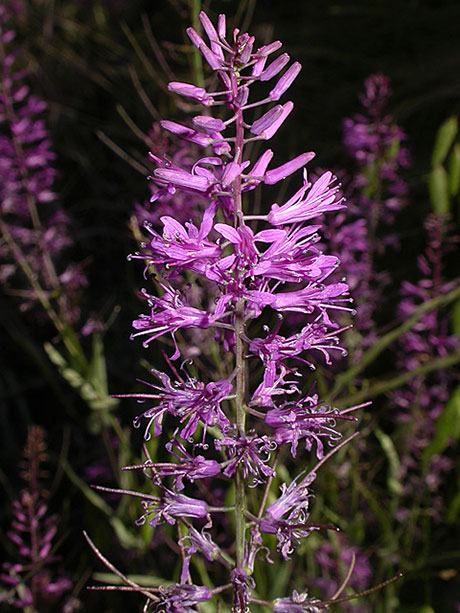
Arrow-leaf thelypody is a biennial or short-lived perennial arising from a spreading rootstock. Plants are glabrous (except for leaf petioles) glaucous, and often purplish. Stems are 2-10 dm tall, branched distally, and either simple or branched near the base. Basal leaf petioles are (0.9-) 1.4-3 (-4.5) cm long and ciliate, the blades (2.8-) 3.5-8.8 (-11) cm long by (0.7-) 1-2.5 (-3.5) cm wide, usually oblong to oblanceolate or lanceolate, or rarely ovate or elliptic, acute at the apex, the margins entire to wavy. Cauline leaves are ascending and sessile, the blades 1.8-4.5 (-6) cm long by 0.5-1.6 (-2.4) cm wide, lanceolate to oblong, the base completely clasping to strongly auriculate, margins entire. Flowers are arranged in a lax to somewhat densely-flowered raceme, slightly elongated in fruit. Flower buds are purple and oblong-linear. Sepals are lilac-purple, erect, and linear-oblong, 5-7 (-8) mm long by (0.8-) 1-1.5 (-1.8) mm wide. Petals are dark purple, spatulate to oblanceolate, and attenuate at the base, (6.6-) 7.5-10 (-11.5) mm long by 1-1.8 (-2) mm wide. Anthers are purplish, well exserted, and coiled from the tip downward when fully dehisced. Siliques are narrowly linear, cylindrical, slightly constricted between the seeds, and straight to somewhat incurved, spreading to ascending, (2-) 2.4-5 (-6.5) cm long. Fruiting pedicels are straight or rarely curved, horizontal to spreading, (2.5-) 3-5.5 (-6.5) mm long, the gynophore (the elongated stalk bearing the pistil above the point of attachment of the calyx and corolla) (1-) 2.5-6 (-7.5) mm long in fruit.
Overview
- Species Common Name Arrow-leaf thelypody
- Species Scientific Name Thelypodium eucosmum
- State Listing Status Threatened