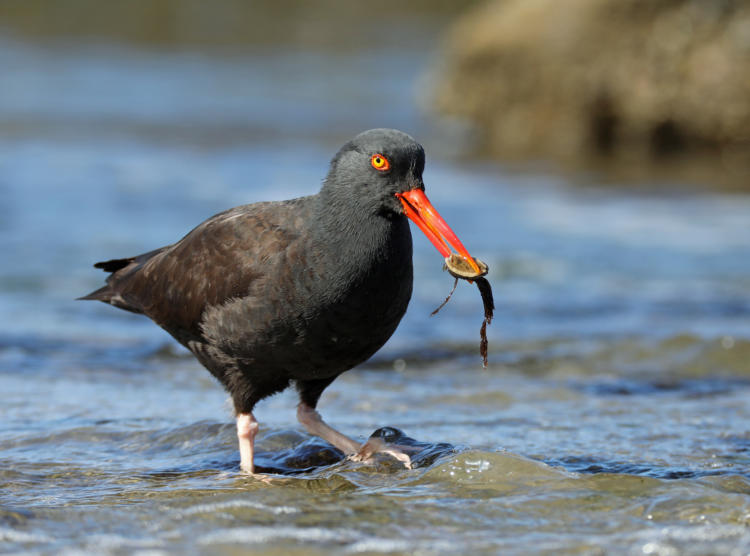
Black Oystercatcher on the Oregon coast. Photo Credit: Keith Kohl
Monotypic and resident, the Black Oystercatcher is a striking shorebird of the ocean shore with a red eye ring, bright yellow eyes, a reddish-orange bill, and pink legs. The Black Oystercatcher is a relatively large bird with a long, thick bill, a thick neck, and long, stocky legs. They have a dark body that is black on the head and neck and dark brown to black elsewhere. Populations from Alaska to Oregon tend to have all blackish plumage while the amount of white feathers and brown on the belly increases from California south to Baja California. Males and females have similar plumage, but females are larger and heavier with a longer bill. Juveniles are brownish black overall with a dark-tipped red bill.
Black Oystercatchers inhabit rocky coastlines and offshore islands in Oregon. Breeding populations are vulnerable to nesting disturbance by native and non-native predators and/or humans and human-caused factors including inappropriate drone usage and off leash dogs. They require sufficient intertidal invertebrate prey. Black Oystercatcher nest sites are located in unvegetated sites above the highwater mark and in the vicinity of intertidal habitat for foraging. There is some evidence that oystercatchers nesting on islands are more successful than on mainland nests although this is dependent on nest height above sea level. Nests located on offshore islands are less accessible to ground predators, less susceptible to egg depredation, and subject to decreased human disturbances.
Limiting factors
Black Oystercatchers nest in small numbers in Oregon. Breeding populations are vulnerable to nesting disturbance by native and non-native predators and/or humans. Availability of suitable habitat that remains relatively disturbance-free during the nesting period may be a primary limiting factor. Successful nesting in Oregon may be restricted to islands, where ground predators, egg depredation, and disturbance are limited or absent. This coastal-dependent species is also highly susceptible to oil spills.
Data gaps
• Continue to assess breeding/wintering population size.
• Model likely impacts of climate change (e.g., sea-level rise) on habitat suitability.
• Improve understanding of population dynamics at local (Oregon) and regional scales.
Conservation actions
• Limit human disturbance in nesting and foraging areas.
• Utilize educational signage in key nesting and foraging areas.
• Employ interpretation and outreach efforts to minimize disturbance impacts at key high-use sites.
Key reference or plan
Black Oystercatcher (Haematopus bachmani) Conservation Action Plan. Read here
Liebezeit, J., A. O’Connor, J.E. Lyons, C. Shannon, S. Stephensen, and E. Elliott-Smith. 2020. Black Oystercatcher (Haematopus bachmani) population size, use of marine reserve complexes, and spatial distribution in Oregon. Northwest Naturalist 101: 14-26.
A global assessment of the conservation status of the Black Oystercatcher Haematopus bachmani. Read here