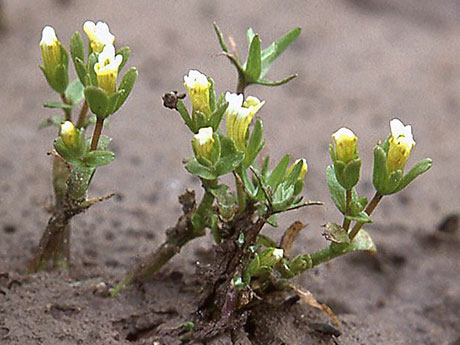
Boggs Lake hedge hyssop is a semi-aquatic annual with erect, striate stems 2-10 cm high, stout, tubular, and glabrous below, slender above, and glandular-pubescent in the inflorescence. Leaves are opposite, each pair arranged on the stem at right angles to the pair above and below, the lowermost linear-lanceolate and 1-2 cm long, the upper reduced, obovate, rounded or emarginate, and 2-5 mm long. Flowers are few and borne on slender, erect, glandular-pubescent pedicels lacking bracts. Sepals are unequal, the lower two distinct, 4-6 mm long, oblong, obtuse, and emarginate, the upper three fused for 1/3 their length or more, the middle lobe emarginate, broader and longer than the lateral two. The corolla is tubular and 5-lobed, 6-8 mm long, the lobes 1-2 mm long, the upper pair yellow and fused nearly to the tip, the lower three white with deeper sinuses. The corolla tube is yellow, somewhat curved, quadrate, exceeding the calyx, and pilose with gland-tipped hairs on the external surface and a few simple hairs within. Stamens 2, with short, slender filaments attached approximately midway on the tube below the upper pair of corolla lobes. The capsule is pear-shaped, about equaling the persistent calyx.
Overview
- Species Common Name Boggs Lake hedge hyssop
- Species Scientific Name Gratiola heterosepala
- Federal Listing Status Species of Concern
- State Listing Status Threatened