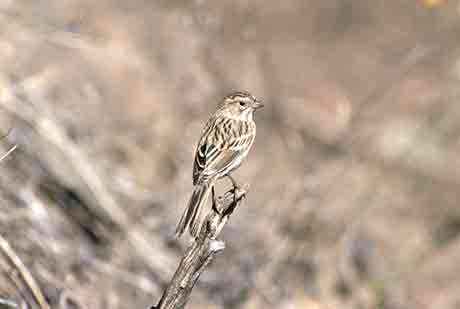
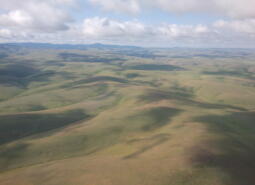
Brewer’s Sparrow (Spizella breweri) is a rather drab, nondescript sparrow species. It has plain brownish upperparts and crown, faint facial markings, and whitish breast. They are well camouflaged in their sagebrush breeding habitat of eastern Oregon. The are migratory, only spending the breeding season in Oregon. They overwinter in southwestern United States and Mexico in grasslands.
Brewer’s Sparrows are typically found in shrublands that are less than 1.5 m in height and dominated by big sagebrush (Artemisia tridentata). Brewer’s Sparrow may breed in other habitat types when sagebrush is not available. They nest in thick crowns or low in brush or in clumps of grass. Abundance is most closely associated with availability of big sagebrush, and negatively correlated with shrub diversity and cover of litter, grass, and rock outcrops. Preference is shown for mid to late successional stands of sagebrush scrub.
Limiting factors
Brewer’s Sparrow populations face significant threats due to the reduction and fragmentation of suitable nesting habitats within sagebrush ecosystems. One factor contributing to habitat loss is the invasion of non-native plant species, such as cheatgrass and crested wheatgrass, which have replaced native sagebrush species across much of eastern Oregon’s ecoregions. The shift towards cheatgrass is exacerbated by grazing practices, which further disrupt the natural balance of sagebrush steppe habitats. This degradation and fragmentation of sagebrush habitats have become a significant threat for Brewer’s Sparrows. Additionally, juniper encroachment into sagebrush areas can further degrade the habitat.
Data gaps
• Assess distribution in Oregon.
• Determine longevity and survival rates for Oregon.
• Conduct taxonomic research.
Conservation actions
• Maintain suitable shrublands for breeding, and retain quality of mid to late successional sites
• Maintain connectivity among habitat patches.
• Mitigate for impacts of invasive non-native grasses
Key reference or plan
PIF Focal and Imperiled Species. Rockwell et al. 2022. Read here
Conservation of Landbirds and Associated Habitats and Ecosystems in the East Cascade Mountains. Read here