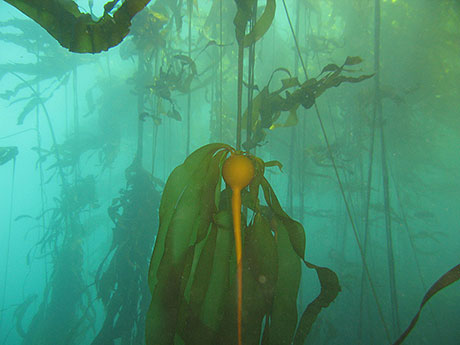
Bull kelp is a brown alga that can grow to about 115 feet long. A tough root-like structure called a holdfast anchors it to the rocky bottom of the nearshore. The long, hollow stem-like stipe grows from the bottom up towards the surface buoyed by a single large air bladder bulb from which the leaf-like blades grow. Between 30-60 blades grow from the top of the air bladder. Bull kelp absorbs dissolved nutrients and water directly from seawater through its blades, unlike vascular plants that absorb water and nutrients from the soil through their roots. Bull kelp grows in relatively shallow waters that have a rocky bottom and is often found in dense patches know as kelp forests or kelp beds. Bull kelp form spores with a single set of chromosomes on patches of their blades called sori. These sori form near the base of the blades and become more mature as they grow further away from the base. The sori fall away from the blade as they release spores. An enormous number of spores are produced, and they are released quickly when they are ready with an estimated average of 1.5 million per square inch of sori per minute. The spores have two whiplike tails called flagella that allow them to move. Spores may settle close to the large kelp soon after being released, helping ensure kelp beds appear in the same places the following year, or they may drift with currents and settle elsewhere to establish new kelp beds. Spores that are successful germinate into the microscopic gametophyte generation of bull kelp, with one set of chromosomes, that produces sperm and eggs. Very little is known about the microscopic gametophytes that grow from the spores and how long they can live, but the seasonality of bull kelp indicates that most produce gametes (eggs and sperm) within 2-3 months. Bull kelp eggs are immobile and release a chemical cue called a pheromone that attracts the mobile sperm, but only at very close range, so the density of settled spores that produce the gametophyte generation must be high, about 645-6,450 spores/in2, for the next generation of the large sporophytes to succeed and kelp beds to form. Bull kelp is generally an annual, with the large sporophyte generation growing quickly up toward the surface in spring, becoming most visible at the surface in Oregon starting in July, dropping spores in late summer and fall, and the microscopic gametophyte generation present during the winter months after the large bull kelp generation has been torn from the bottom by fall and winter storms.
Overview
- Species Common Name Bull Kelp
- Species Scientific Name Nereocystis luetkeana