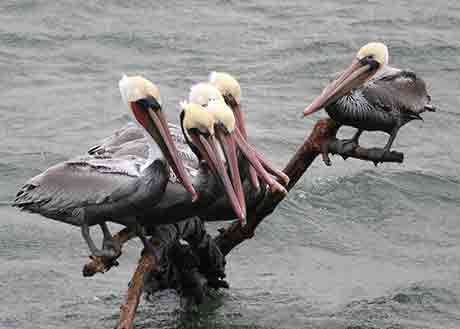
The California Brown Pelican (Pelecanus occidentalis californicus) is the only subspecies of Brown Pelican found in Oregon and along the western coast of North America. It is easy to identify by its large size, massive bill, and brownish body feathers.
This species is social and often seen in large flocks, either flying over the ocean or feeding just offshore. In Oregon, the California Brown Pelican is mostly a non-breeding visitor, seen along the coast from spring through fall. Sometimes, large flocks gather during migration. It is rarely seen far inland or beyond the edge of the continental shelf.
Although it typically doesn’t breed in Oregon, there have been a few rare breeding attempts recorded.
Overview
Species Common Name California Brown Pelican
Species Scientific NamePelecanus occidentalis californicus
California Brown Pelicans are primarily marine, and in Oregon, are found on shorelines, estuaries, and offshore rocks. California Brown Pelicans rely on nearshore, pelagic, and estuarine habitat for foraging. They use offshore rocks and islands, inaccessible headland areas, sandy islands, and sand spits for roosting and nesting. The East Sand Island population in the Lower Columbia River is the largest roosting site in Oregon. California Brown Pelican distribution and abundance along the Pacific Coast has expanded and contracted in recent years related to long-term ocean cycles and prey abundance.
Limiting factors
Forage fish availability may be a key limiting factor for Brown Pelicans, particularly near breeding colonies. Pelicans are highly vulnerable to oil spills. Point source contamination has compromised breeding success. Numbers of pelicans in Oregon are related to natural cycles of ocean warming and cooling that impact prey availability and pelican productivity. Major population declines were recorded in the 1960s and 1970s caused by reproductive failure due to eggshell thinning caused by DDT in the U.S. in 1972 and in Mexico in 2000.
Data gaps
• Evaluate the effects of human disturbance on Brown Pelican roosting behavior and breeding success.
• Determine the extent of nesting in Oregon.
• Investigate the impacts of marine renewable energy development and entanglement in fishing gear on this species.
Conservation actions
• Minimize disturbance on roosting islands in the Lower Columbia River Estuary and along the Oregon coast.
Key reference or plan
Draft Post-Delisting Monitoring Plan for the Brown Pelican (Pelecanus occidentalis). Read here