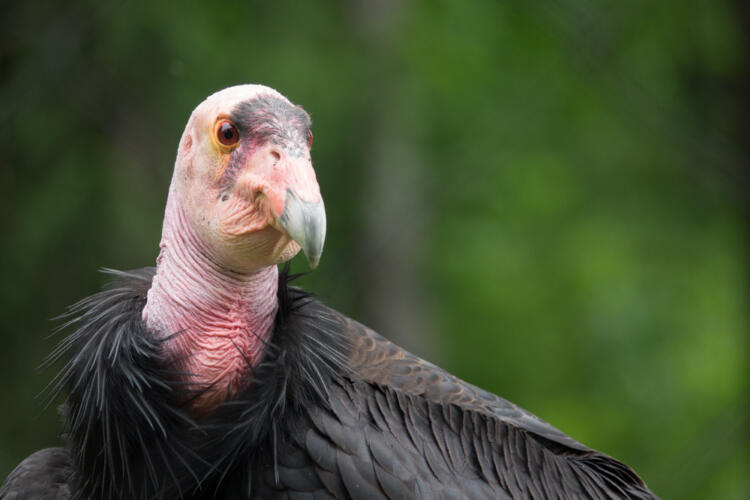
The California Condor is one the largest and one of the most endangered species in North America which vanished form Oregon more than 120 years ago. Ongoing reintroduction efforts and planning for reintroductions are expected to result in the return of the California Condor to Oregon in the foreseeable future.
The California Condor has a wingspan of about 2.8 m, and body weight of about 8.5 kg. Sexes are similar in size and coloration, although males (8.8 kg) average slightly heavier than females. Adults are mostly black with a naked orange/pink/yellowish head and neck (color varies depending on state of aggression or sexual display) and a well-developed dark feather ruff around the lower neck. Bill is elongated and is hooked at the end; mostly ivory in color, and is enclosed by fleshy, naked tissue for most of its length. Feet and tarsus unfeathered with relatively short claws. Leg color is generally dark gray.
Overview
Species Common Name California Condor
Species Scientific NameGymnogyps californianus
Federal Listing Status Endangered
Ecoregions
No associated ecoregions found.
Special needs
California Condors require large areas of remote habitat for foraging, roosting, and nesting. They use large trees and rocky outcroppings as perching sites. Within their current distribution, their occurrence is often associated with supplemental feeding stations.
Limiting factors
California Condors are especially sensitive to lead toxicity from feeding on contaminated carrion, pesticide exposure, and outbreaks of highly pathogenic avian influenza (HPAI).
Data gaps
• Assess effectiveness of Oregon’s non-lead hunting education program in creating suitable habitat for the species.
• Assess barriers to successful recovery in Oregon.
Conservation actions
• Evaluate potential Oregon release sites.
• Record and communicate any observations of the species in Oregon.
• Mitigate impacts of HPAI outbreaks.
• Encourage use of non-lead ammunition
Key reference or plan
5 Year Status Review, May 2021, Establishment of experimental population of the California Condor in the Pacific NW, March 2021. Read here