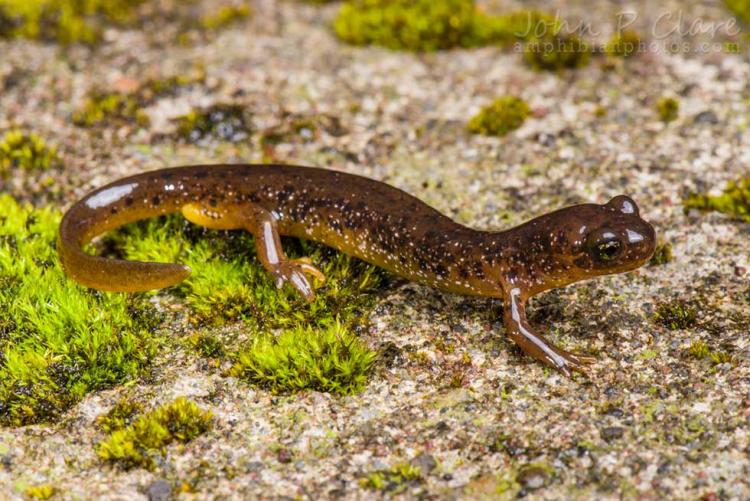
Cascade torrent salamanders are long-lived amphibians adapted for life in cold, fast-flowing streams. They are small salamanders with a stocky body, a broad head, and large protruding eyes. Adult Cascade torrent salamanders have highly variable coloration that ranges from brown to olive to tan on their backs. Their bellies are yellowish with some black and white dots. They are often highly spotted on their sides, which accentuates the color change from their backs to their abdomens. Adults will typically reach just over two inches in length measured from their snout to their vent. Males are slightly smaller than females and have distinctive squared off lobes at the base of the tail. Larvae have small heads and eyes close to their snout. They look similar to adults, with short, reddish, external gills and tail fins. Cascade torrent salamanders are members of the genus Rhyacotriton, which includes four closely related species endemic to the Pacific Northwest. These four species were only recognized as distinct species in 1992.
Cascade torrent salamanders are found in cold, fast-flowing headwater streams, seeps, and waterfall splash zones in forested areas. They typically occur in reaches and off-channel habitat with gravel or cobble substrate and persistent, shallow water. Larvae are aquatic, and both larvae and adults use rocks and other microhabitat features for foraging and cover. Adults can also be found along stream banks and in upland areas during wet periods. This species requires continuous access to cold, silt-free water and moist adjacent forest. Torrent salamander habitat quality is most ideal on north-facing slopes.
Limiting factors
Torrent salamanders are highly sensitive to desiccation, warm temperatures, and ground disturbances that result in increased sedimentation in streams. Climate change is likely to have a profound impact on torrent salamanders as these species depend on cold water and moist conifer forests for survival. Torrent salamanders have a limited capacity to rebound after disturbances, as larvae take several years to reach sexual maturity, and adults have a small clutch size (7-16 eggs), with eggs needing up to 10 months to hatch. Larvae have minute gill surface area and are very sensitive to temperature and sediment. Increased fire intensity and frequency can lead to severe wildfires that may increase sedimentation and alter stream biochemistry and water temperature. Habitat loss from timber harvest, increased sedimentation, and climate change, as well as patchy distribution, small range, and local extirpations are threats to Cascade torrent salamander populations.
Data gaps
• Determine occurrence of the species in suitable habitat areas.
• Assess population trends for Cascade torrent salamanders, establish comprehensive baseline population status
• Determine main causes of mortality and morbidity for the species
• Determine specific in-stream habitat needs for each life stage
• Assess how reproduction and age-at-reproductive maturity varies by habitat conditions
• Assess and monitor effects of riparian buffer widths and upland forest management strategies on distribution, abundance, dispersal, and gene flow.
• Evaluate risks to species from climate change.
• Evaluate the effects of land management practices, fertilizers, pesticides, and herbicides on this species.
• Implement monitoring and adaptive management programs to better understand impacts of Oregon forest practices on headwater amphibian species.
• Develop monitoring techniques for species that are difficult to detect.
Conservation actions
• Protect headwater streams
• Retain riparian buffers to maintain cool water temperatures and water clarity (see Partners in Amphibian and Reptile Conservation recommendations)
• Minimize sediment coating or embedding of rocky substrates
• Maintain aquatic and adjacent terrestrial habitat (including over ridges) for dispersal and to enhance habitat connectivity
• Use results of dispersal studies to guide recommendations on culvert size or modification (see Partners in Amphibian and Reptile Conservation recommendations)
• Minimize habitat alteration and disturbance at suitable sites
• Identify and prioritize protection and management of habitats with higher climate resiliency
Key reference or plan
Howell, B. L. and N. M. Maggiulli (2011). Conservation assessment for the Cascade torrent salamander (Rhyacotriton cascadae). U.S.D.A. Forest Service Region 6 and U.S.D.I. Bureau of Land Management Version 1.0;
Leppin, M. V., C. Rombough, C. Cousins, L. Bennett, R. Duncan, M. Radin, and A. Domen (2020). Terrestrial movement by the southern torrent salamander (Rhyacotriton variegatus). Northwestern Naturalist 101:56;
Olson, D. H. and A. Ares (2022). Riparian buffer effects on headwater-stream vertebrates and habitats five years after a second upland-forest thinning in western Oregon, USA. Forest Ecology and Management 509:120067.
Pilliod, D.S. and E. Wind. (editors). 2008. Habitat Management Guidelines for Amphibians and Reptiles of the Northwestern United States and Western Canada. Partners in Amphibian and Reptile Conservation, Technical Publication HMG-4, Birmingham, AL. 139 pp. Read here