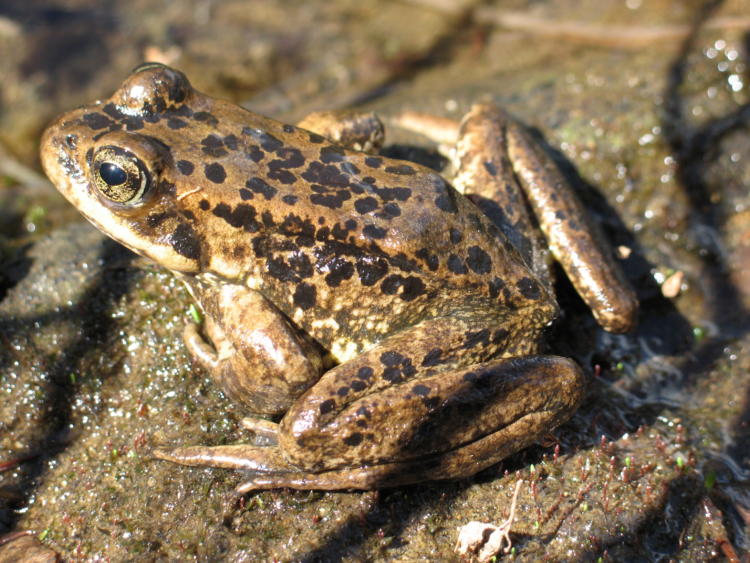
Cascades frog adult at Tipsoo Lake, Mt Rainier National Park, WA Photo Credit: Brome McCreary, U.S. Geological Survey
Cascades frogs are a medium-sized montane frog species that can be found near still or slow-moving fresh water. They are brown to olive green in color above, and most individuals have angular or round black spots on the back. Underneath, their skin is nearly translucent, with a mottled throat and a yellow-tan abdomen. Cascades frogs have a distinct dorsolateral fold, a ridge of raised skin that runs down the length of either side of their body to their hip. They have distinct facial markings: a dark facemask, golden-colored eyes oriented toward the side, and a white upper jaw stripe. Adult females can grow up to three inches in length, while smaller males grow up to 2.5 inches long from snout to vent. Tadpoles are dark brown with coppery speckling, and can grow up to two inches in length. During the spring breeding season, males advertise for potential mates with a quiet series of low, grating clucks.
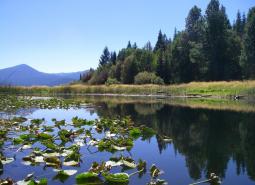
Cascades frog occur primarily in aquatic habitats including bogs, ponds, lakes, snowmelt pools, flooded wetlands, slow-moving streams, and other ephemeral wetlands. They use shoreline areas for foraging and basking, and dispersal typically occurs along stream corridors but may include upland habitats during wet conditions. This species is found in alpine and subalpine coniferous forests of various ages above 2,400 feet elevation. They require access to permanent water for foraging and overwintering. During the breeding season, eggs are laid in slow-moving water along the shallow sunny edges of ponds, where warm sunlight speeds egg development. Overwintering occurs in aquatic habitats.
Limiting factors
This montane species is vulnerable to genetic isolation. It has experienced substantial reductions in the southern parts of its range, particularly in California. Cascades frogs are potentially sensitive to waterborne pathogens as well as diseases including chytrid fungus. Altered disturbance regimes (fire suppression), sedimentation (livestock grazing/watering), and predation and competition by introduced fish are additional threats. Declining water availability (changes in snow pack/melt and summer drought) associated with climate change may further affect habitat quality and extent.
Data gaps
• Investigate habitat requirements and how they vary by elevation across the species’ range.
• Identify habitat characteristics that could enhance migration and gene flow.
• Describe feeding habits.
• Evaluate the effects of pathogens and airborne environmental pollution on this species.
• Explore the feasibility of reintroduction at historically occupied sites.
• Conduct baseline inventory and monitoring to evaluate changes in distribution and population trends.
• Assess vulnerability to climate change, particularly in drier portions of the species’ range.
• Evaluate the effects of land management practices, fertilizers, pesticides, and herbicides on this species.
Conservation actions
• Maintain habitat connectivity and restore degraded or encroached meadow habitats.
• Monitor and address impacts of fish stocking and poor water quality.
• Consider impacts to the species from livestock grazing in occupied wet meadows, and carefully manage grazing to ensure compatibility
• Use prescribed burning or hand-felling of trees periodically to manage plant succession.
• If reintroductions are warranted, use individuals from nearby sites and consult results of feasibility studies.
• Conduct outreach and education to help limit local impacts from public recreation. Install wildlife-friendly crossings along at problem roads such as near major breeding sites.
• Identify and prioritize protection and management of habitats with higher climate-resiliency.
• Establish priorities for disease monitoring and implement treatment or prevention programs as needed
Key reference or plan
An updated assessment of status and trend in the distribution of the Cascades frog (Rana cascadae) in Oregon, USA; Species status assessment for the Cascades frog (Rana cascadae). Version 1.0 draft. January 2022. Portland, OR. 93 pages + appendices Read here