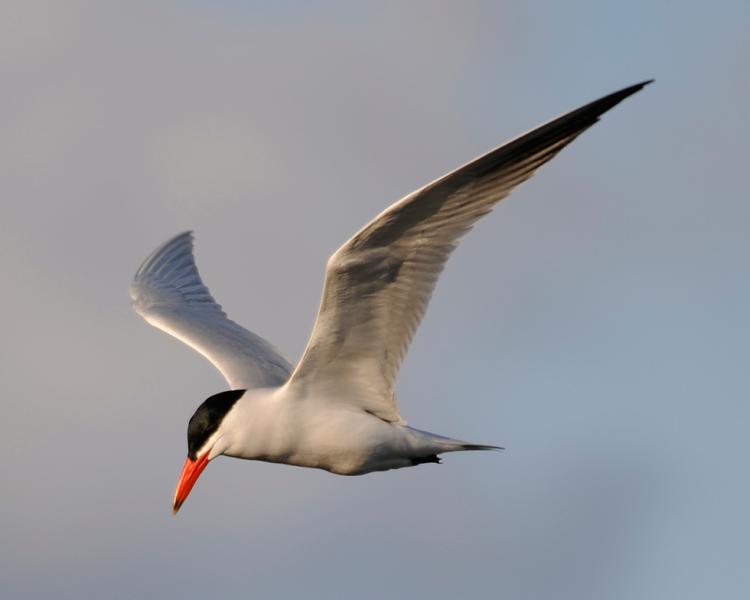
The Caspian tern (Hydroprogne caspia) is the world’s largest tern. It is gull-like in behavior and characteristics. It is distinguished by its massive coral-red bill, large size, and hoarse vocalizations. It occurs on every continent except for Antarctica.
In summer plumage the Caspian Tern has pale gray upperparts, white underparts, and white rump and tail. Its black cap extends distinctly below eye and terminates in a small, ragged crest at the back of the head. The wing tips are back.
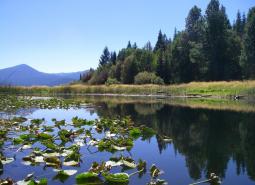
Caspian Terns typically use flat, open, and mostly unvegetated islands for nesting. They prefer sites that are free of ground predators and often nest in dense colonies, frequently alongside other colonial waterbirds. Suitable nesting areas include natural islands and islands created or modified by humans. A reliable water supply is essential to maintain island habitat and support consistent foraging opportunities. Fluctuations in water level (e.g. due to drought or water management) can reduce suitability of nesting islands and affect forage availability. In western North America, Caspian Terns originally nested at inland freshwater sites, but their range expanded substantially during the 20th century due to habitat loss at those sites. Today most Caspian terns across the West nest in coastal estuarine environments, but they can be found along coastlines, lakes, or large rivers, as well.
Limiting factors
Long-term availability of suitable nesting sites is important to this species. As a colonial-nester, Caspian Terns are especially vulnerable to human-induced or natural events that affect colonies and productivity. The regional population is vulnerable to metapopulation effects related to persistent breeding failures at East Sand Island (Lower Columbia River) including breeding failures resulting from colony disturbance and subsequent predation, especially related to compound predation by bald eagles and gull species. Habitat degradation at breeding sites results from drought and climate change and vegetation encroachment.
Data gaps
• Evaluate metapopulation stability following decline of the large East Sand Island colony.
• Determine breeding productivity at other colony sites in Oregon.
• Investigate resilience of existing tern habitat to climate warming and increased drought risk.
Conservation actions
• Protect breeding colonies from human disturbance.
• Collaboratively evaluate regional habitat needs and encourage creation and management of new habitats in areas where conflicts with fish are not a concern.
• Support management of existing colonies as needed to improve occupancy and productivity.
• Implement actions as identified in the U.S. Fish and Wildlife Service’s Status Assessment and Conservation Recommendations (Shuford and Craig 2002)
Key reference or plan
Caspian Tern Management to Reduce Predation of Juvenile Salmonids in the Columbia River Estuary, Final Environmental Impact Statement. Read here