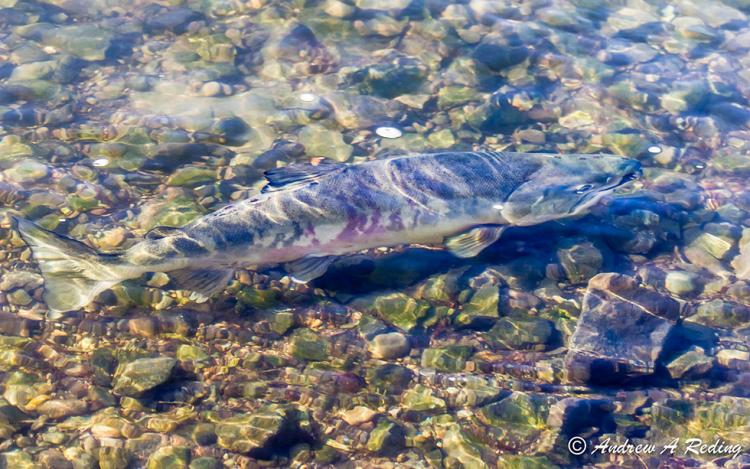
Require stream gravel bars with cold, upwelling seeps or springs and side channels near tidewaters for spawning. Fry migrate to ocean soon after emergence and use edge habitat for cover. Productive nearshore marine habitat that provides high-quality prey in sufficient quantity for rapid growth at time of ocean entry.
Limiting factors
Alterations of hydrology and watershed function. Fish passage, especially barriers low in the watershed. Marine survival. Loss of estuarine habitat. Fry very susceptible to mortality from Ceratonova shasta, which is more prevalent in higher water temperatures.
Data gaps
Population dynamics information limited due to difficulty in analyzing marks of hatchery-raised individuals (i.e., otolith thermal marks require sacrificing and genetic analysis is expensive). Distribution and abundance in Cascade Stratum, Gorge Stratum, and Oregon marine waters. Fisheries-dependent data to determine bycatch and mortality in LCR fisheries. Carrying capacity of occupied streams. Competition with other salmonids. Predation at all life stages. Unknown what types of habitat restoration projects specifically benefit Chum. Defined population recovery numbers.
Conservation actions
Strategy 1: Maintain a self-sufficient chum salmon conservation hatchery program at BCH that can support substantial out planting in two Coastal stratum recovery populations.
Strategy 2: Coordinate chum salmon out planting with effectiveness monitoring to facilitate evaluation and adaptive management.
Strategy 3: Prioritize monitoring of adult chum salmon to evaluate out planting efficacy, document natural recolonization, and investigate distribution.
Strategy 4: Collect information and develop plans for expansion or transition of recovery actions to the Cascade and Gorge strata. Continue ongoing restoration and recovery efforts involving landowners, tribes, and agency partners (NOAA, NMFS, ODFW, OWEB, WDFW, OSU). Manage for sustainable harvest.
Key reference or plan
Recovery Plan for Lower Columbia River Coho Salmon, Lower Columbia River Chinook Salmon, Columbia River Chum Salmon, and Lower Columbia River Steelhead. Read here