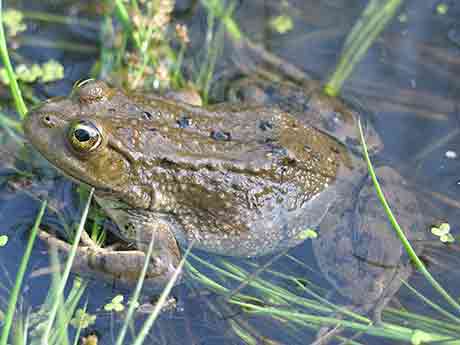
Columbia spotted frogs are one of the most highly aquatic frog species native to the Pacific Northwest, and are rarely found out of the water. They are adapted for this aquatic lifestyle, with upward oriented eyes that allow them to see out of the water while mostly submerged, fully webbed feet, and relatively short hind legs. These medium sized frogs grow up to two to four inches in length from snout to vent, with adult females growing significantly larger than males. Adults are variable in color, ranging from tan to dark brown, olive green, or gray on their backs to match their environment. They have moist bumpy skin covered in dark, leopard-like spots that darken with age. Their underparts are an opaque cream-color with a bright yellow or pink wash on their lower abdomen and legs. They have inconspicuous dorsolateral folds, or ridges of skin that run the length of their body on the sides of their back. Oregon spotted frogs and Columbia spotted frogs were classified as one species until genetic analysis showed that they were distinct species.
Overview
- Species Common Name Columbia Spotted Frog
- Species Scientific Name Rana luteiventris
- Federal Listing Status Species of Concern
- State Listing Status Sensitive
Ecoregions
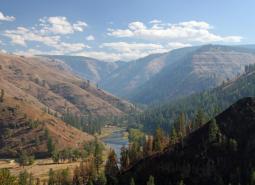
Blue Mountains
Located in NE Oregon, the Blue Mountains ecoregion is the largest ecoregion in the state. It provides a diverse complex of mountain ranges, valleys, and plateaus that extend beyond Oregon into the states of Idaho and Washington.
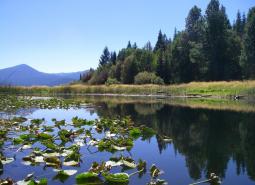
East Cascades
The East Cascade ecoregion extends from the Cascade Mountains' summit east to the warmer, drier high desert and down the length of the state. This ecoregion varies dramatically from its cool, moist border with the West Cascades ecoregion to its dry eastern border, where it meets sagebrush desert landscapes.
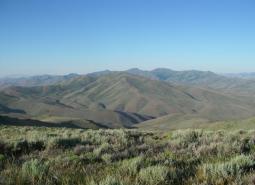
Northern Basin and Range
The Northern Basin and Range ecoregion covers the very large southeastern portion of the state, from Burns south to the Nevada border and from the Christmas Valley east to Idaho. It is largely a high elevation desert-like area dominated by sagebrush communities and habitats.