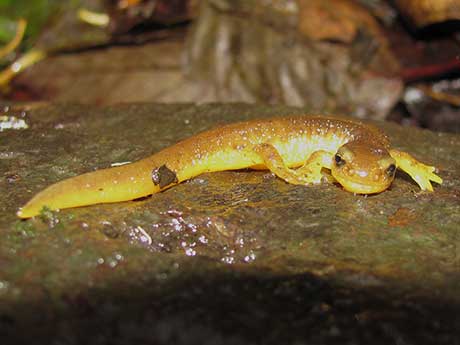
Columbia torrent salamanders are long-lived, highly aquatic amphibians that are closely associated with cool, clear headwater streams. They are slim, mid-sized salamanders with a short tail, a small head, rounded snout, and protruding eyes. They are dark brown with no dark spots on their back, and bright yellow or orange underneath. Adult males are slightly smaller than adult females, and have squared off lobes at the base of the tail. Adults may grow to be three to four inches in total length, snout to tail. Columbia torrent salamanders are one of four species of torrent salamanders that were treated as one species until 1992 when genetic analysis showed these species were distinct. Geographic location is important to note when identifying specimens in this genus. Columbia torrent salamanders can be distinguished from the other three species by the absence of spots or blotches on their backs. They have a straight, relatively indistinct line of demarcation where the ground color changes between the color on their back.
Columbia torrent salamanders are found in mature, coastal, coniferous forests in cold mountain streams, spring heads, seeps, and waterfall splash zones. They are also associated with habitat on north-facing slopes, intermittent or discontinuous headwater habitat, and shallower habitats in higher-order streams. They require reaches with loose gravel and cobble stream beds and generally prefer basalt over softer geological substrates with low amounts of fine sediments. Adults may generally be more common in high-gradient streams, however the Columbia torrent salamander is considered a headwater obligate, as eggs are laid in low-flow headwater streams where larvae remain for up to five years. Metamorphosed adults continue to occupy these stream habitats, but also leave natal streams and move to forests during wet conditions for foraging and dispersal. Downed wood and forest cover provide the cool, moist microclimate required by Columbia torrent salamander for terrestrial activity and dispersal.
Limiting factors
Columbia torrent salamanders are highly sedentary and have limited dispersal capabilities. Adults are particularly sensitive to desiccation, and larvae are vulnerable to changes in stream flow. These vulnerabilities may increase the susceptibility of Columbia torrent salamanders to effects of climate change. Forest disturbances that increase fragmentation have negative effects on dispersal and may limit gene flow. Limited dispersal restricts gene flow, and continued isolation could lead to an increase in homozygosity and inbreeding. The range of this species overlaps significantly with privately- and state-owned lands which are managed for timber harvest, with few occurrences in federally protected or reserved land-use classifications.
Data gaps
• Increase basic knowledge of abundance, distribution, and trends through inventory and monitoring.
• Evaluate response to forest management activities at varied scales.
• Implement monitoring and adaptive management programs to understand impacts of Oregon Forest Practices on headwater amphibian species.
• Evaluate the effects of land management practices, fertilizers, pesticides, and herbicides on this species.
• Evaluate risks to species from climate change.
Conservation actions
• Protect headwater streams.
• Retain riparian buffers to maintain cool water temperatures and water clarity (see Partners in • Amphibian and Reptile Conservation recommendations).
• Minimize sediment coating or embedding of rocky substrates.
• Maintain aquatic and adjacent terrestrial habitat (including over ridges) for dispersal and to enhance habitat connectivity.
• Use results of dispersal studies to guide recommendations on culvert size or modification (see Partners in Amphibian and Reptile Conservation recommendations).
• Minimize habitat alteration and disturbance at suitable sites.
• Identify and prioritize protection and management of habitats with higher climate resiliency.
Key reference or plan
Leppin, Mark V., Chris Rombough, Christopher Cousins, Logan Bennett, Riley Duncan, Matt Radin, and Andrea Domen “TERRESTRIAL MOVEMENT BY THE SOUTHERN TORRENT SALAMANDER (RHYACOTRITON VARIEGATUS),” Northwestern Naturalist 101(1), 56-60, (19 February 2020). Read here
Leppin, M. V., C. Rombough, C. Cousins, L. Bennett, R. Duncan, M. Radin, and A. Domen (2020). Terrestrial movement by the southern torrent salamander (Rhyacotriton variegatus). Northwestern Naturalist 101:56
Olson, D. H., and A. Ares (2022). Riparian buffer effects on headwater-stream vertebrates and habitats five years after a second upland-forest thinning in western Oregon, USA. Forest Ecology and Management 509:120067
Pilliod, D.S. and E. Wind. (editors). 2008. Habitat Management Guidelines for Amphibians and Reptiles of the Northwestern United States and Western Canada. Partners in Amphibian and Reptile Conservation, Technical Publication HMG-4, Birmingham, AL. 139 pp. Read here
Russell, K. R, T. J. Mabee, and M. B. Cole. 2004. Distribution and Habitat of Columbia Torrent Salamanders at Multiple Spatial Scales in Managed Forests of Northwestern Oregon. J. of Wildlife Mgmt.