Submit photo to: Conservation.Strategy@ODFW.state.gov
Tawny to orange-brown dorsally, with black markings. Both males and females have black chains along the dorsal wing margins, although the chaining is light in males and heavy in females. The ventral hindwing disc color varies from shades of light brown to brandy-colored with the silver orbs large and ovoid. The silver spots are relatively bold, accentuated by rims of black scales. In the marginal row, the ventral hindwing has flattened, inwardly rounded silver spots, broadly and flatly capped with olive-tan. The yellow submarginal band is narrow on the ventral hindwing. The ventral hindwing silver spots are not visible from above as lighter areas (i.e., they do not show through the wing). With a wing span of 5 to 8.6 cm (2 to 3.375 in.), this species is relatively large for the genus. It is somewhat squarish in wing outline, with the apices of the forewing drawn out and protruding forward.
Overview
Species Common Name Coronis Fritillary (butterfly)
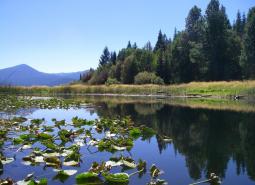
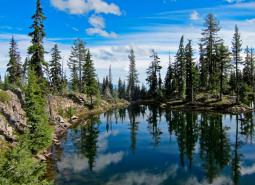
This species inhabits mountain slopes, foothills, dry gulches, lower elevation canyons, prairie valleys, meadows, chaparral, sage steppe, and forest glades, margins, and openings. Generally associated with serpentine influenced, rocky hill-slopes dominated by Jeffery pine (Pinus jeffreyi) and other serpentine associated forbs and grasses. Larvae in this species feed strictly on violets (Viola spp.). In this subspecies, adults are strongly attracted to the flowers of mint and thistle along the borders of mountain streams, and have been collected from these plants, as well as lilac blooms and Yerba Santa bushes (Eriodictyon spp.), in the Siskiyou region. At higher elevation sites where S. coronis nr. coronis adults move to in the summer, adults appear to have a strong preference for azalea flowers.
Limiting factors
Low elevation grassland habitats of this subspecies are threatened by urbanization, development, and agriculture. Conifer encroachment, wildfire, and grazing are potential threats at historic, current, and suspected sites.
Data gaps
Collect life history information. Document seasonal migration patterns. Obtain current population size and trend data. Assess distribution and determine range. Determine microhabitat requirements.
Conservation actions
Monitor existing populations and habitat. Survey suitable habitat for new populations. Manage habitat to provide preferred host and nectar plant species. Protect new and known occupied sites.
Key reference or plan
Fallon, C., S.F. Jordan, and E. Scheuering. 2020. Interagency Special Status/Sensitive Species Program (ISSSSP) Species Fact Sheet: Speyeria coronis nr. coronis. USDA Forest Service Region 6 and USDI Bureau of Land Management Oregon State Office. 22 pp.