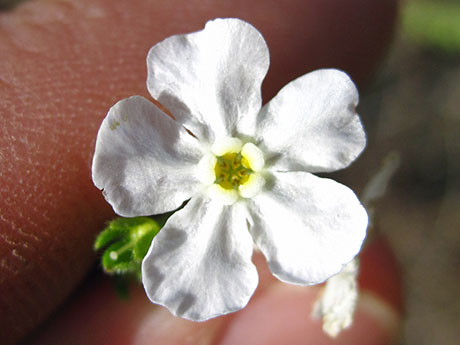
Cronquist’s stickseed is an erect, taprooted perennial 20-65 cm tall. Stems are glabrous below the middle and sparsely antrorse-strigose above, arising from a compactly branched caudex. Leaves are hirsute or strigose, the basal leaves usually persistent, narrowly elliptic or lance-elliptic, 6-14 (-21) cm long by 0.5-2 (-3.5) cm wide, with long petioles. Cauline leaves are narrowly elliptic to narrowly oblong or sometimes lanceolate, 2.5-11 (-14.5) cm long by 0.2-0.8 (-1.3) cm wide, strongly ascending, mostly sessile, and progressively smaller upward along the stem, the bracts small and insignificant in the inflorescence. Flowers are white tinged with blue, the corolla limb 0.8-1.5 cm wide, the tube 2-2.2 mm long, shorter than to slightly exceeding the calyx lobes. The fornices in the throat of the corolla have papillate to papillate-puberulent appendages. Nutlets are lanceolate to lance-ovate, (2.5-) 3-3.5 mm long, the dorsal surface strongly warty with firm, stiff hairs and short and long prickles ranging from (0.2-) 0.5-3.5 (-4) mm long.
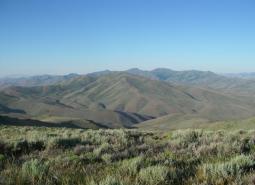
Cronquist’s stickseed occurs on sandy sagebrush slopes, and occasionally on moist slopes of ravines. This species is found at elevations between 2000-3640 feet.
Limiting factors
Cronquist’s stickseed has limited distribution. Intensive grazing, herbicide and insecticide use, agricultural development, invasive plant and crop seeding competition, and unregulated off-road vehicle and equestrian use threaten this species. The species is also highly vulnerable to climate change because of its limited dispersal/movement abilities, increased probability of wildfire in sagebrush communities dominated by invasive plants, and sensitivity to altered hydrologic regimes.
Data gaps
Evaluate the effects of light grazing on this species to determine its utility as a management tool. Develop propagation and transplanting protocols. Survey for additional populations.
Conservation actions
Continue to implement the Habitat Management Plan on public (Bureau of Land Management) land: manage recreational access, herbicide use, grazing, and insecticide use during flowering periods to maintain populations. Collect and store seeds.