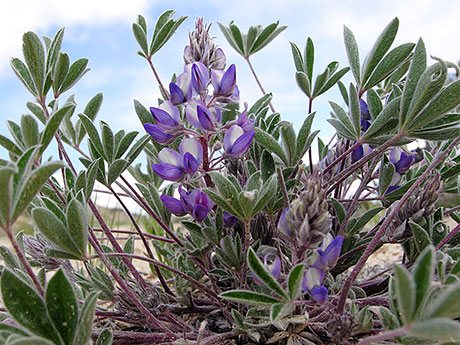
Cusick’s lupine is an erect, caespitose perennial 2-11 cm tall. Stems are sparingly branched at the base, with upper stem internodes 1-3 cm long. Upper stem nodes often bear a lateral branch terminating in an inflorescence. Leaves are mainly basal, the petioles 2-6 cm long, the 5-9 oblanceolate leaflets abundantly hairy on both surfaces, 0.7-1.9 cm long by 0.3-0.7 cm wide. Peduncles are 1-6 cm long, subequal to or shorter than the racemes. Racemes are 1-6 cm long, and held at about the height of the vegetative crown when mature. Flowers are crowded and whorled, borne on slender pedicels 0.4-0.5 cm long at anthesis. The calyx is hairy and not saccate or spurred. The corolla is bluish, the banner usually lighter in color, glabrous, and 0.4-0.6 cm wide.
Overview
Species Common Name Cusick's lupine
Species Scientific NameLupinus lepidus var. cusickii
Cusick’s lupine is found on loose, rocky soils and barren ash deposits on moderate to extreme slopes.
Limiting factors
This endemic species is believed to be limited to Baker County and Idaho. Cusick’s lupine is vulnerable to uncontrolled off-road vehicle use, invasive species, and livestock grazing. Microclimate conditions drive population dynamics. The species is highly vulnerable to climate change because of its restricted habitat, anthropogenic barriers, and predicted changes to hydrologic regimes.
Data gaps
Determine factors affecting plant reproduction and population density. Assess genetic diversity and reproductive success. Research annual population variability and estimate long-term trends.
Conservation actions
Survey potential habitat for additional populations. Manage grazing and off-road vehicle use at known sites. Continue monitoring of known populations.