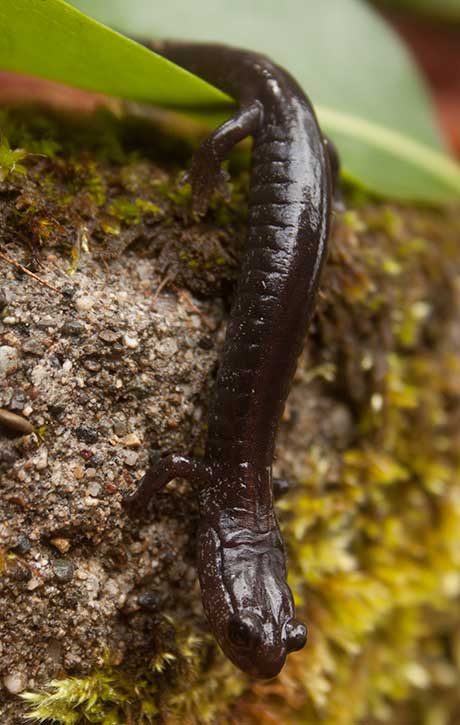
Del Norte salamanders are a species of fully terrestrial salamander native to a small corner of southwestern Oregon and northwestern California. They do not need standing water to complete any part of their life cycle. These medium-sized salamanders have long, slender bodies with short limbs and short, slightly webbed toes. They spend much of their time underground, only emerging during wet periods. Adults are solid dark brown or black in color, with a rusty, even-edged stripe from the head to the tip of the tail that fades with age. Adults average 2.3 to 3 inches in length snout to vent, and 4.3 to 5.9 inches in total length. They have between 17 and 20 costal grooves, which are pronounced vertical indentations on their sides. Juveniles hatch looking just like adults, but with a more obvious stripes on their back. They are a member of the Plethodontidae family of lungless salamanders. Like all plethodontid salamanders, they have two grooves connecting their nostril and mouth. They breathe through their moist skin and tissues in their mouth. They are very closely related to Siskiyou Mountains and Scott Bar salamanders, and it can be difficult to distinguish between the three species. Subtle morphological differences may be present, but field identification in areas of range overlap may not be conclusive.
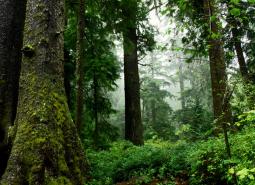
Del Norte salamanders occupy coastal redwood and north coast Douglas-fir forests of northwestern California and southwestern Oregon. The species is fully-terrestrial and found in closed-canopy coastal forests with mixed hardwood/conifer. They do not require standing water, yet are highly dependent on the moisture in their environment. Del Norte salamanders are generally associated with forested, moist talus slopes and rocky substrates, often among rock rubble, old riverbeds, or under bark, logs, and leaf litter on the forest floor. They often found underground where conditions are more humid, and are reluctant to forage on the surface during periods of heat and desiccation. This species prefers late-seral forests but does occur in mature and young coastal forest stands in lower densities.
Limiting factors
This fully terrestrial species is highly sedentary. Individuals typically remain within 7.5 square meters in a given year. Low dispersal rates and small home range size are thought to increase vulnerability of populations to disturbances such as fire and fire suppression, warming and drying climate trends, and loss of habitat due to land use changes including forest management practices that affect canopy cover and surface debris.
Data gaps
• Assess distribution.
• Increase knowledge of life history and population ecology, including phenology, dispersal and seasonal movements, and longevity.
• Evaluate genetic diversity and influence of chytrid fungus infection on populations.
• Evaluate the effects of land management practices, fertilizers, pesticides, and herbicides on this species.
• Evaluate risks to species from climate change.
• Continue to evaluate new survey techniques to improve detectability.
• Assess climate vulnerability
Conservation actions
• Identify and retain important habitat for conservation using species’ habitat requirements and movement patterns.
• Minimize alteration and disturbance to coastal forested talus and stream substrate.
• Minimize habitat alteration and disturbance at occupied sites.
• Consider animal movement needs in planning and management activities.
• Consider timing of management actions to limit overlap with periods of salamander surface activity.
Key reference or plan
Evelyn, C. and S. Sweet (2018). Del Norte salamander (Plethodon elongatus) species account for U. S. Forest Service Region 5, pre-public review draft. USDA Forest Service, Pacific Southwest Region.