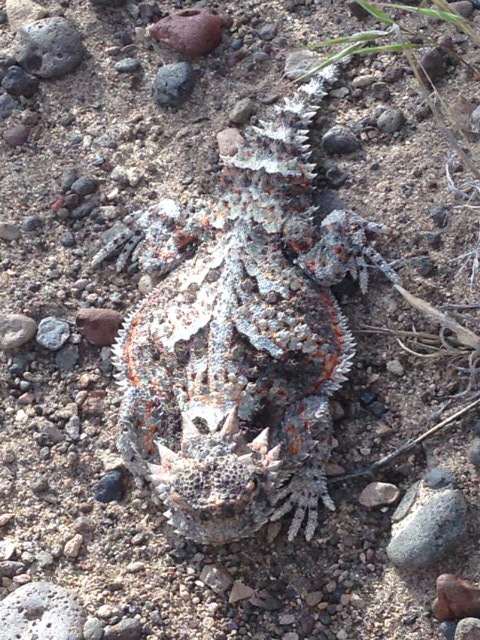
The desert horned lizard is a small, round lizard with large, pointed scales that protrude from the back of their heads, giving them the appearance of having horns. They are well camouflaged in their surroundings with beige, tan, brown, or slightly reddish body color that can match the rocky soils found in the desert
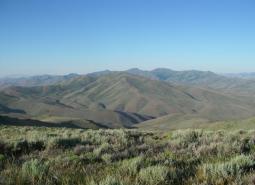
The desert horned lizard occupies areas with open understory and shrubs for thermorefugia. It burrows into loose substrate among roots of desert shrubs for hibernation.
Limiting factors
Occurrence of desert horned lizard is low Oregon within its restricted range, but the species can be locally abundant in suitable habitat. Species is vulnerable to habitat destruction, degradation (including by invasive species), and overcollection. The species is identified as particularly sensitive to climate change concerns. Historically, this was a species subject to high levels of commercial collection in Oregon and neighboring states, and though this is prohibited, the species likely is impacted from poaching. Specific threats to desert horned lizard include fire, grazing, cheatgrass and other nonnative grass encroachment, energy development, and OHV recreation. Off road vehicle recreation increases risk of direct mortality and likely impacts habitat suitability.
Data gaps
• Collect data on population occurrence and trends.
• Assess the implications of various land uses and other threats on suitable habitat.
• Assess habitat loss over time.
• Determine how habitat loss, various land uses, habitat connectivity, invasive plant species, and other threats impact prey availability (harvester ants).
• Estimate impacts from vehicle mortality and collection.
• Quantify effects of climate change on persistence and population trends.
• Revisit historical sites to document changes in occupancy.
Conservation actions
• Maintain and enhance habitat.
• Control invasive species.
• Prevent illegal collection.
• Conduct surveys before implementing land management actions to avoid impacts to populations.
Key reference or plan
Bureau of Land Management. 2022. Strategic Plan for Amphibian and Reptile Conservation. U.S. Department of the Interior, Bureau of Land Management, Division of Wildlife Conservation, Aquatics, and Environmental Protection, Lakewood, CO. Read here
Mims et al. 2018. Functional and geographic components of risk for climate sensitive vertebrates in the Pacific Northwest, USA. Read here