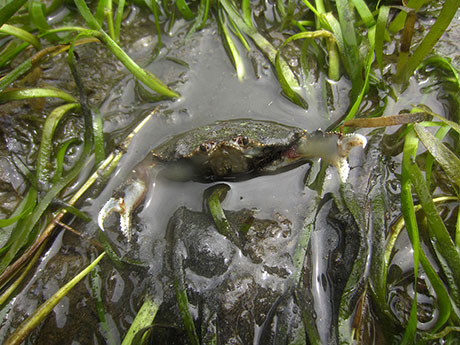
Dungeness crab are large, sandy-red colored crustaceans that have a lifespan of 8 to 13 years and typically grow up to 180 to 200 mm at their widest point. Adults have four pairs of walking legs, two pincers (claws), and a wide carapace, all of which seasonally become filled with musculature which is a prized source of seafood. Commercial and recreational take of Dungeness crab constitutes one of the most valuable marine fisheries along the west coast of North America. Dungeness crab are most often found in areas with sandy bottoms but they also occur in a variety of habitat types, including eelgrass beds, mud and gravel. They typically occur in the intertidal zone down to depths between 50 to 90 m, and some Dungeness crab have been found as deep as 800 m. High densities of megalopae larvae and recently settled juveniles frequently occur seasonally in the intertidal and subtidal zones of Oregon estuaries, but the vast majority of individuals inhabit deeper-water areas year-round along the Continental Shelf. Dungeness crab are considered to be scavengers that use their pincers to eat clams, crustaceans and small fish. In addition, they also cannibalize other Dungeness crab. As crustaceans with a hardened carapace and legs, Dungeness crab must periodically molt in order to grow. The molting process (ecdysis) allows the crab to regenerate lost limbs and incrementally increase their size over their lifespan. Dungeness crab are highly vulnerable to predators during the first few weeks after molting due to the softness of their new shell, which takes about two months to harden fully. Molting occurs six times a year for the first two years of a crab’s life, and older crab molt once a year (with females molting in the spring and males molting in the summer). Fertilization occurs in fall and winter when females deposit eggs into the abdominal flap. In the winter, female crab will bury themselves in sand or mud and become inactive to protect their brooded embryos and developing larvae. Zoea larvae are typically released in the early spring, and the free-swimming zoea and megalopa larvae disperse in ocean currents for a period of three to four months. Supplies of Dungeness crab larvae can vary annually by a factor of 1,000 and strongly influence the population dynamics along the Oregon coast, which is considered to be part of the large connected metapopulation . The biogeographic range typically extends from the Aleutian Islands (AK) to Point Conception (CA).
Overview
- Species Common Name Dungeness crab
- Species Scientific Name Metacarcinus magister