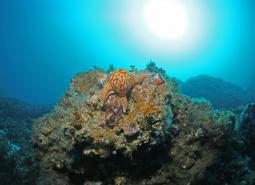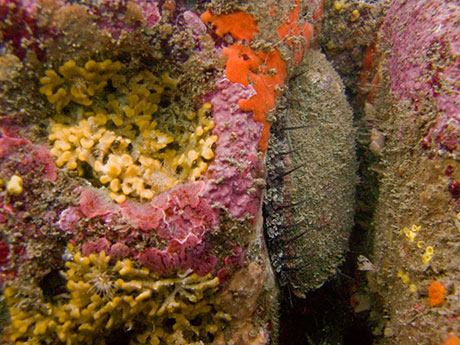
The flat abalone is a medium-sized abalone (maximum shell length 175 mm, most individuals are 25 to 125 mm) with a flattened oval shell, a red lip, and an epipodium that is mottled yellow and dark-brown. Flat abalone shells are typically dark, brick red with occasional streaks of greenish-blue and white, and they have four to eight excurrent openings (tremata; five to six are open and the rest are sealed closed). They inhabit rocky shores where they live on or under rocks and in deep crevices, and their depth range extends from the low intertidal zone into subtidal areas to a depth of 20 m. Like other abalone, flat abalone are herbivores that capture drift algae and graze upon small attached seaweeds and filamentous blue-green algae. Flat abalone have separate sexes, and they broadcast their gametes freely into the surrounding seawater when they spawn. Fecundity increases proportional to body size, and a mature female can release 10,000 to 11 million eggs. Fertilized eggs develop into embryos and free-swimming lecithotrophic veliger larvae that remain in the water column for about one to two weeks. Cabezon (Scorpaenichthys marmoratus) are known to prey upon flat abalone, and other predators include crab, octopi and other species of fishes. The shells of flat abalone are frequently weakened by boring clams and sponges. Flat abalone were historically the target for a small commercial fishery in Oregon (1 permitted harvester; 2001-2008), and the local population declined to near-zero following an extreme marine heat wave and declines in the abundance of bull kelp (2015-2017). Recent surveys have not recorded any observations of living flat abalone over the past few years, and it is possible that they may have become locally extinct along the Oregon coast. Northern California to southern Oregon is the species stronghold, few observations have been made outside that range. The full biogeographic range extends from Washington (WA)Depoe Bay, OR to San Benito Island Northern, Baja California (MX).
Overview
- Species Common Name Flat abalone
- Species Scientific Name Haliotis walallensis