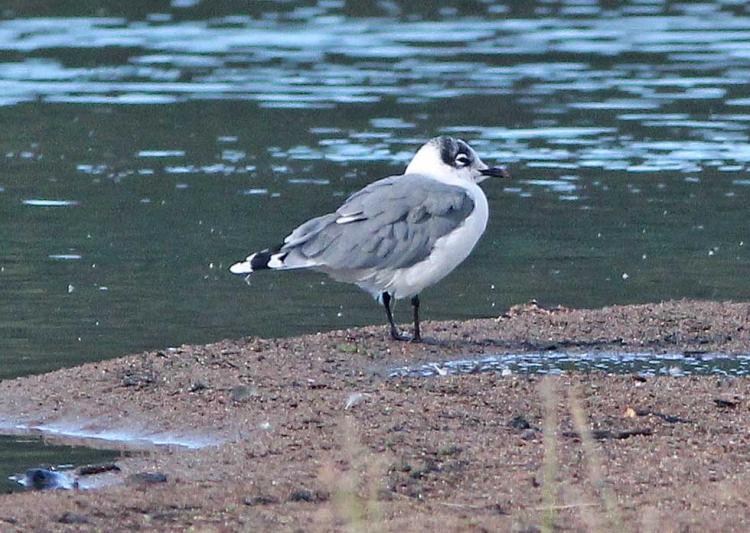
The Franklin’s Gull (Leucophaeus pipixcan) is a small gull that breeds in wetlands including freshwater marshes, lakes, and wet meadows. During the breeding season, it has a jet-black hood, which contrasts sharply with its white neck and breast, gray back, and bright red bill. In Oregon, they are typically seen in this distinctive breeding plumage. Adult Franklin’s Gulls measure about 12 to 14 inches in length and weigh between 8 and 12 ounces. Unlike most other North American gulls, Franklin’s Gulls rely heavily on flying insects and other invertebrates, which they often catch in flight. These gulls are long-distance migrants, traveling south through Mexico to spend the winter along the Pacific coast of South America, particularly in Peru and Chile. They are one of only two North American gull species that migrate south of the equator.
Franklin’s Gulls depend upon extensive marshes for breeding, where they nest over water on floating vegetation and in colonies. Breeding sites are characterized by both emergent vegetation for nest attachment and deep-water habitat that provides foraging opportunities and prevents access to nests by predators. They forage in the shallower marshes and grasslands surrounding lakes. Sometimes breeding birds forage in uplands, and when grasshoppers are abundant, in plowed fields. Franklin’s Gulls are long-distance migrants that breed in and around the Great Plains and migrate south through Mexico to winter along the Pacific coast of South America.
Limiting factors
Franklin’s Gull occurs in small, disjunct breeding colonies in Oregon. The specialized nesting requirements of this species make them vulnerable to fluctuating water levels. They are also sensitive to human disturbance at nesting sites, especially in the pre-nesting and chick phases.
Data gaps
• Continue to document population demographics and population size and trends in Oregon
• Improve understanding of foraging ecology and factors influencing dependence on marsh versus upland foraging areas (e.g., marsh size, characteristics).
• Describe breeding and post-breeding habitat needs in a landscape context; use this information to direct water-level management across a matrix of sites.
Conservation actions
• Minimize human disturbance in nesting areas during the breeding season and in shallow-water feeding areas.
• The species is vulnerable to habitat loss; maintain existing suitable habitats.
• Where appropriate, manage water levels to provide suitable foraging and nesting habitat.
• Partner with biologists on wintering grounds to assess conservation priorities
Key reference or plan
Waterbird Conservation for the Americas. Read here