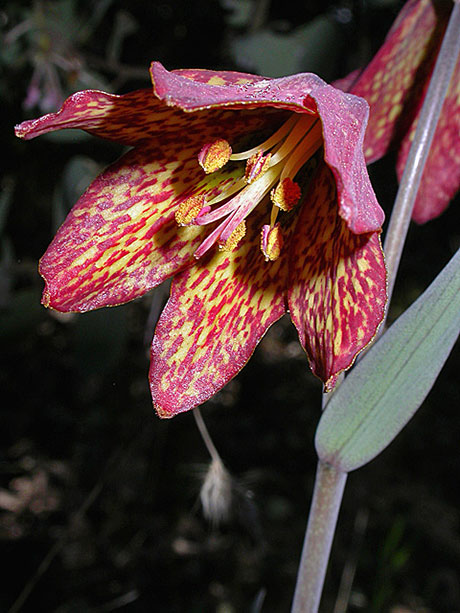
Gentner’s fritillary is a perennial herb arising from a fleshy bulb, with one to twelve deep red to maroon bell-shaped flowers produced on a single, erect, 40 to 70 centimeter tall flowering stalk. The leaves of reproductive plants occur in whorls along the stalk, while vegetative plants produce a single basal leaf varying in length from 0.5 to 29 centimeters. Most reproduction occurs through asexual production of small “rice grain” bulblets on the surface of mature bulbs – these detach from the mother bulb and develop into new individuals. In general, the majority of the plants in a population are vegetative (rather than flowering), with numerous basal leaves (each representing one individual bulblet) massed near each flowering stalk.
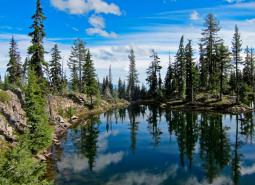
Gentner’s fritillary occurs in a wide range of habitat types, including woodlands dominated by Oregon white oak, moist riparian areas, Douglas fir forests, and serpentine sites. This species generally prefers ecotones between meadows and open woodlands.
Limiting factors
Loss of habitat and habitat degradation due to invasive plant infestations, road construction, agricultural disturbances, urban development, grazing, off-road vehicle use, and trail maintenance adversely affect this species.
Data gaps
Use molecular techniques to investigate population structure and to estimate proportion of F. gentneri relative to F. recurva and F. affinis at sites across recovery units.
Conservation actions
Continue implementing actions in the recovery plan. Minimize impacts from road maintenance and construction on existing roadside populations. Continue monitoring existing populations. Continue land acquisition and protection of populations.
Key reference or plan
A U.S. Fish and Wildlife Service Recovery Plan was released for Gentner’s fritillary in 2003. A Species Status Assessment Report was published in 2022 (https://iris.fws.gov/APPS/ServCat/DownloadFile/249004).