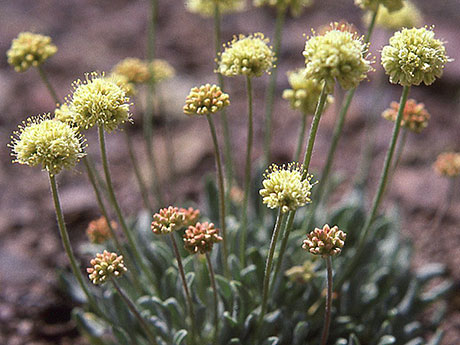
Golden buckwheat is a low, matted perennial 2-10 cm tall by 5-20 cm in diameter, growing from a woody caudex with matted stems. Stems bear persistent leaf bases and reach up to 1/5 the height of the plant. Leaves are basal and arranged in tight terminal clusters, the petiole 0.2-0.5 (-0.8) cm long and tomentose, the blade oblanceolate to spatulate, (0.5-) 0.7-1 cm long by 0.2-0.4 (-0.5) cm wide, and densely white- or grayish-tomentose on both surfaces. Inflorescences are capitate, 0.5-1.5 cm wide, subtended by 3-5 scalelike triangular bracts 1-2 mm long, and borne on erect, slender scapelike stems. Involucres number 3-5 per cluster, are turbinate-campanulate to campanulate, 2.5-3 (-3.5) mm by 2.5-3 mm, membranous, and glabrous, with 5 sparsely floccose, erect teeth 0.6-1.2 mm long. Flowers are yellow, (2-) 2.5-3 mm long, sparsely glandular or infrequently glabrous, tepals oblong to narrowly obovate and 1/3 connate at the base, stamens 2-2.5 (-3) mm long and exserted, filaments pilose at the base. Achenes are light brown, 2.5-3 mm long, and glabrous except for a minutely bristly beak.
Overview
- Species Common Name Golden buckwheat
- Species Scientific Name Eriogonum chrysops
- State Listing Status Threatened