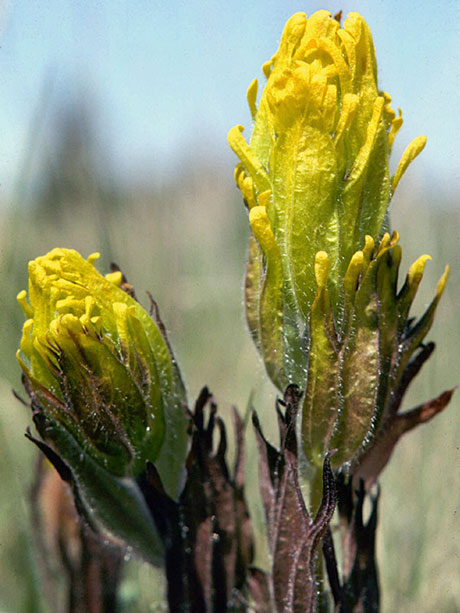
Golden paintbrush is a perennial with many stems growing from a short branching base. Stems are usually simple, erect, or slightly decumbent at the base, 10-50 cm tall, and softly viscid-villous. Leaves are viscid-villous to hispidulous, 2-4 cm long, closely ascending, the lower leaves linear-lanceolate and entire, the upper leaves oblong-ovate or -obovate with 1-4 pairs of shallow lobes toward the apex. The inflorescences are straight and erect, with flowers remote and mostly hidden by overlapping bracts. Bracts are golden yellow, sometimes tinged with reddish-orange, about equal to the width of the upper leaves, oblong, obtuse, and usually lobed at the apex. The calyx is 1.5-1.8 cm long, externally pubescent, deeply and subequally cleft above and below, the primary lobes again deeply 2-lobed with linear obtuse segments. The corolla is 2.0-2.3 cm long, the slender galea 0.6-0.9 cm long, puberulent, and about 3-4 times longer than the unpouched lower lip.
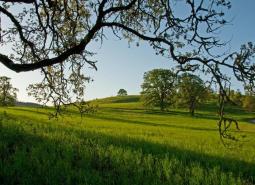
Golden paintbrush historically occurred in low-elevation open prairies with moist winter soils (but no standing water). This species was also associated with gravelly glacial outwash or outcrops of clayey glacio-lacustrine sediment.
Limiting factors
Golden paintbrush is threatened by habitat loss due to urbanization and commercial and agricultural development. Encroachment of woody plants as a result of fire suppression is also harmful to this species. Competition with non-native, invasive weeds, trampling by recreationists, and severe herbivory by deer and rabbits present further threats.
Data gaps
Evaluate and determine reasons for regionwide population declines. Conduct long-term demographic monitoring to relate population trends to climate variables and extreme events. Describe pollinator associations and status. Continue evaluating optimal host species for golden paintbrush.
Conservation actions
Continue experimental reintroduction and augmentation. Monitor experimental reintroduction and augmentation and determine management practices or habitat conditions linked to success or failure. Develop and implement optimal management practices (including fire) to promote population growth. Continue post-delisting monitoring and consider relisting the species if population declines continue.
Key reference or plan
A U.S. Fish and Wildlife Service Recovery Plan (https://ecos.fws.gov/docs/recovery_plan/000823.pdf) was released for golden paintbrush in 2000. A U.S. Fish and Wildlife Service Recovery Plan (https://ecos.fws.gov/docs/recovery_plan/100629.pdf) for prairie species of western Oregon and southwestern Washington was released in 2010 and addresses conservation needs of golden paintbrush.
A U.S. Fish and Wildlife Service Species Status Assessment (https://iris.fws.gov/APPS/ServCat/DownloadFile/166807) was completed for golden paintbrush in 2019.