Submit photo to: Conservation.Strategy@ODFW.state.gov
The Great Basin Ramshorn (Helisoma newberryi) has what has been described as a stout shell, diameter approximately 13 mm; with whorls that do not increase rapidly in width, but body whorls that are larger, with simple aperture offset downwards at steep angles. H. newberryi is described as medium to large, ultradextral, body whorl angulated; spire depressed or elevated, the whorls terraced and angular; base funicular; last whorl broad at the periphery, rapidly attenuated below; aperture triangular, outer lip thin; inner lip with slight callus.
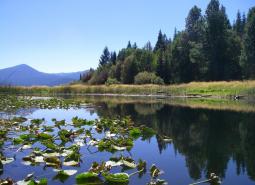
Helisoma newberryi is a local endemic with very specialized and uncommon habitat. It requires well-oxygenated, clean, cold, flowing water supported by larger spring sources and spring-fed pools, lakes, low gradient rivers, and creeks. This species is one of the few to be found generally in Upper Klamath Lake. This species prefers muddy environments where macrophytes are present. It is generally found just below the sediment surface as this species typically burrows into soft mud and is a detritus feeder. This species may also be found in deeper water, ~ 5 m (>16 ft.)
Limiting factors
This species has a very restricted distribution. Habitat loss and degradation, including spring alteration and decreased water flow, represents a major threat to the Great Basin ramshorn. Sedimentation and nutrient inputs from dredging, mining, road construction, and other land use practices may smother substrates or reduce egg survival. Cattle grazing near water sources may pollute sites with feces and urine. Areas with eutrophication or hypoxic events will not support this species, nor will areas with dense beds of macrophytes.
Data gaps
Assess distribution. Determine species-specific habitat requirements. Collect life history and population data. Research the tolerance range of this species to changes in temperature and hydrologic regimes.
Conservation actions
Maintain appropriate water flow and quality. Prevent or mitigate for water diversions, dredging, or other activities that could increase sediment or nutrient levels. Minimize grazing access at occupied sites. Monitor populations and habitats. Survey suitable habitat for new populations.
Key reference or plan
Petition to list the Great Basin Ramshorn (Helisoma Newberryi) as a Threatened or Endangered Species under the Endangered Species Act. 2024. The Center for Biological Diversity. 18 pp.
Hietala-Henschell, K., T. Stone, and R. Huff. 2019. Interagency Special Status/Sensitive Species Program (ISSSSP) Species Fact Sheet: Helisoma newberryi. USDA Forest Service Region 6 and USDI Bureau of Land Management Oregon State Office. 18 pp.