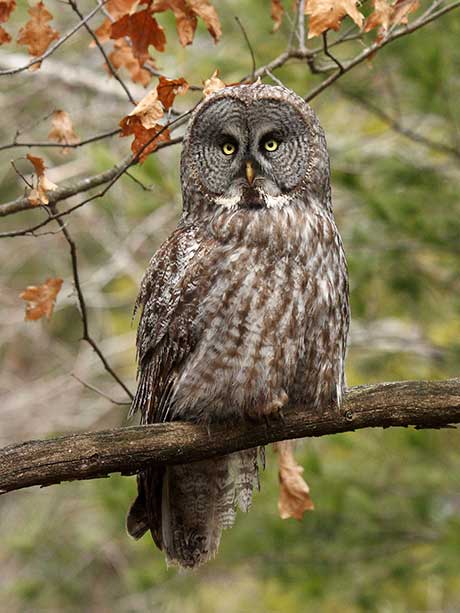
The Great Gray Owl, Strix nebulosa, is North America’s tallest owl, standing 60-84 cm. Great Gray Owls have a thick layer of insulative down that gives them a bulky appearance that provides the necessary insulation for the cold environments they live in. Their plumage is overall a muted gray, comprised a mix of gray, brown and white mottled feathers with slightly streaked underparts. Great Gray Owls have large round heads which lack ear tufts; a broad, round facial disc that is marked with six to eight prominent, concentric rings; and yellow eyes. The throat is marked with a black and white patch that resembles a bow-tie. The bill is typically yellow or ivory in color. Legs are fully feathered, with bare feet.
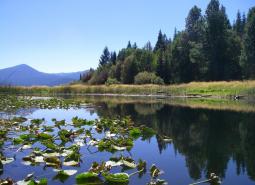
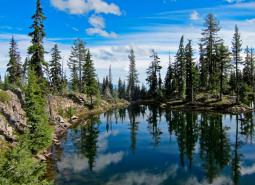
Great Gray Owls use late-successional forests for nesting, and grassy openings for foraging. Nests are typically found on large-diameter snags or large-branch structures. That nesting and roosting habitat must be near open meadows with dense prey populations. Prey consists almost completely of small mammals—chipmunks, voles, mice, shrews, and young ground squirrels.
Limiting factors
The Great Gray Owl requires large forested landscapes interspersed with montane grassland clearings. The loss of the mosaic of these habitat types negatively affects the species. Logging has fragmented its forest habitat and has had the greatest impact on habitat availability and quality. Historical fire suppression has further degraded nesting and foraging habitats by reducing forest structural diversity, increasing forest density, and allowing woody encroachment into meadows and other natural openings. Fire suppression has also elevated the risk of stand-replacing wildfires, which can further degrade habitat suitability. Great Gray Owls are also susceptible to secondary poisoning from rodenticides used to control small mammal populations.
Data gaps
• Assess population status and trends.
• Develop a better understanding of distribution and genetic diversity.
• Evaluate response to forest management activities at varied geographic and spatial scales.
• Assess the value of harvested forest clearings used as foraging habitat.
• Evaluate the effects of rodent control on Great Gray Owls, including secondary poisoning.
Conservation actions
• Maintain late-successional forests with natural, open meadows.
• Use prescribed fire when practicable to maintain habitat.
• Practice thinning or removal of trees that encroach upon meadows. Modified forest management can enhance habitat for Great Gray Owls by opening up dense forest stands.
• Protect known nest sites from logging.
• Enhance nest site availability. This species readily accepts artificial platforms, even when previously-utilized, natural nest sites are available.
Key reference or plan
Survey Protocol for the Great Gray Owl within the Range of the Northwest Forest Plan. Read here
Conservation Of Landbirds and Associated Habitats and Ecosystems in the East Cascade Mountains of Oregon and Washington. Read here