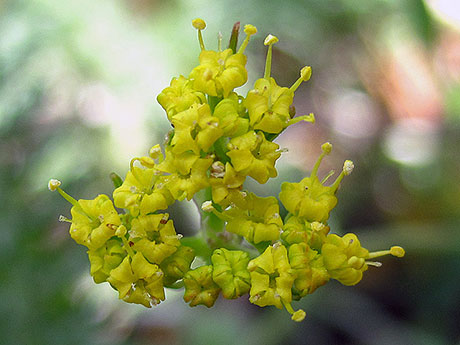
Greenman’s desert parsley is a dwarf perennial, 3-10 cm tall, with slender stems generally bearing a single more or less reduced leaf. Plants become etiolated and considerably taller when occurring in shaded sites. Leaves are chiefly basal, slightly leathery, glabrous, and pinnately or bipinnately divided with lanceolate–ovate leaflets 3-15 mm long by up to 2.5 mm wide. Flowers are small, bright yellow, and occur in tight 0.5-1.2 cm umbellate clusters at the end of the stems, with rays 1-6 mm long. Flowers are borne close to the ground on small plants and are elevated on larger plants. The oval, 3.0-3.5 mm-long fruits are only slightly flattened, and split into halves when completely ripe.
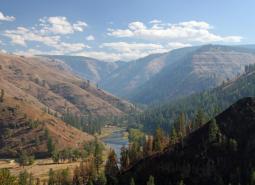
Greenman’s desert parsley is a subalpine species found in meadows or rocky outcroppings. Plants occur on sedimentary soils or basalt substrate.
Limiting factors
Greenman’s desert parsley is naturally rare. This localized endemic is known from three mountain peaks in the Wallowa Mountains. One site is near a nature trail that is accessible by aerial tram and is vulnerable to unintentional trampling. The species is extremely vulnerable to climate change because of limited dispersal capabilities and predicted restrictions of thermal niche.
Data gaps
Conduct reproductive and pollination biology studies. Assess seed germination. Develop propagation and transplanting protocols. Evaluate the impacts of grazing and other potential disturbances on this species.
Conservation actions
Construction of pathways has reduced impacts. Continue to manage recreational use to minimize trampling and monitoring to ensure adequate protections. Survey potential habitat to document additional populations. Educate people about what this species needs to persist and what actions people can take to assist in species’ conservation.
Key reference or plan
A Candidate Conservation Agreement for Greenman’s desert parsley was updated by the U.S. Forest Service and U.S. Fish and Wildlife Service in 2007.