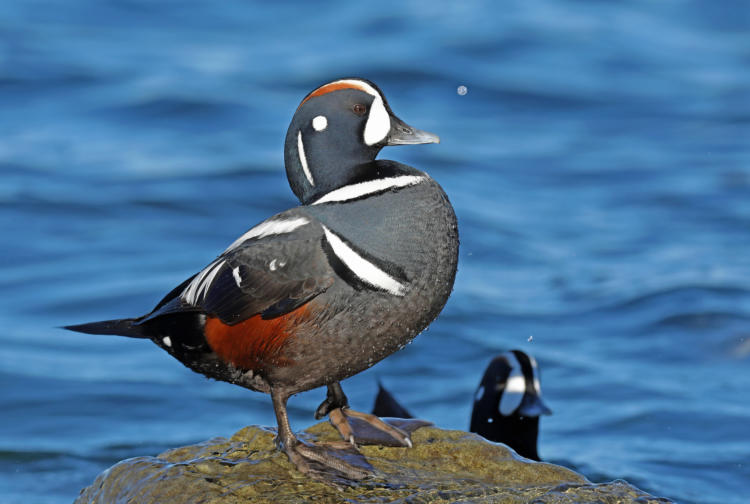
The Harlequin Duck (Histrionicus histrionicus) fills a unique role among North American waterfowl. It breeds in fast-moving, clear rivers and streams, where it uses its strong swimming skills to navigate whitewater. It dives to the bottom of rivers to feed on larval insect in rocky substrates.
After the breeding season, Harlequin Ducks migrate to the coast and spend the winter in the Pacific Ocean. They are a small species of sea duck, with a small bill and long tail.
Males are boldly patterned, with a slate-blue body, a white crescent and spot on the face, a chestnut-colored patch on the crown and flanks, and bold white stripes on the body. Females also have white face markings but are mostly brown in color. Males are larger than females.
Overview
- Species Common Name Harlequin Duck
- Species Scientific Name Histrionicus histrionicus
- Federal Listing Status Species of Concern
- State Listing Status Sensitive
Ecoregions
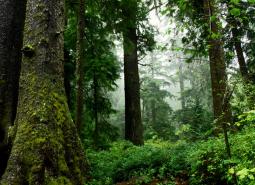
Coast Range
Oregon's Coast Range, known for its dramatic scenery, is extremely diverse, with habitats ranging from open sandy dunes to lush forests and from tidepools to headwater streams. It follows the coastline and extends east through coastal forest to the border of the Willamette Valley and Klamath Mountains ecoregions

West Cascades
The West Cascades ecoregion extends from east of the Cascade Mountains summit to the foothills of the Willamette, Umpqua, and Rogue Valleys, and spans the entire length of the state of Oregon. It is largely dominated by conifer forests, moving into alpine parklands and dwarf shrubs at higher elevations.
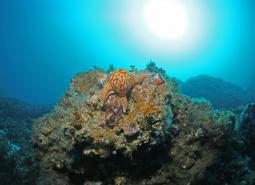
Nearshore
The Nearshore ecoregion includes a variety of habitats ranging from submerged high-relief rocky reefs to broad expanses of intertidal mudflats in estuaries and hosts a vast array of fish, invertebrates, marine mammals, birds, plants, and micro-organisms. This ecoregion encompasses the area from the outer boundary of Oregon's Territorial Sea to the supra-tidal zone, and up into the estuaries.