
Hitchcock’s blue-eyed grass is a rhizomatous perennial herb with 1-3 erect to ascending, mostly unbranched stems. Leaves are shorter than the stems, lax to ascending or strict, and 3-4 mm wide with smooth to finely denticulate margins. Inflorescences are terminal on the stem or pedunculate, with outer bracts longer than inner bracts. There are 2-7 flowers on stout, glabrous pedicels that slightly exceed the inner bracts. The perianth is 14-17mm long, a dark reddish-purple (rarely bluish violet), tips truncate or notched, lacking or infrequently with a yellow eye at the inner base of the corolla. The filament column is 6-9 mm long and purple with glandular hairs at the base of the connate filaments. Anthers are yellow-orange 1.5-2.8 mm long. Fruits are globose capsules 6-7mm long, beige to light brown. Seeds are globose, wrinkled and lacking obvious depressions.
Overview
- Species Common Name Hitchcock's blue-eyed grass
- Species Scientific Name Sisyrinchium hitchcockii
- Federal Listing Status Species of Concern
- State Listing Status Endangered
Ecoregions
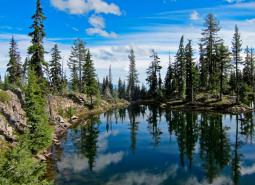
Klamath Mountains
The Klamath Mountains ecoregion covers much of southwestern Oregon, including the Klamath Mountains, Siskiyou Mountains, the interior valleys and foothills between these and the Cascade Range, and the Rogue and Umpqua river valleys. Several popular and scenic rivers run through the ecoregion, including the Umpqua, Rogue, Illinois, and Applegate rivers. Historically, this ecoregion is known …
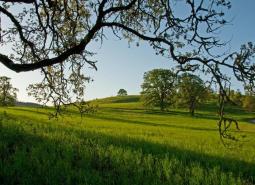
Willamette Valley
The Willamette Valley ecoregion is bounded on the west by the Coast Range and on the east by the Cascade Range. This long mostly level alluvial plain has some scattered areas of low basalt, and contrasts with productive farmland and large urban areas. It has the fastest-growing human population in the state resulting in challenges due to land-use changes.