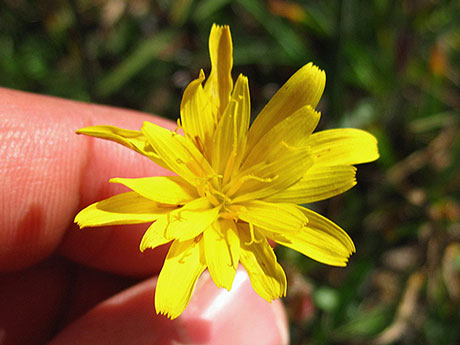
Howell’s microseris is a taprooted perennial 10-50 cm tall, usually with a single, slender, erect stem branched proximally and often distally. Leaves are chiefly basal; linear to narrowly lanceolate or oblanceolate; 10-30 cm long; the margins entire, dentate, or pinnately lobed, the lobes slender and often curved downward or backward. Involucres are narrowly ovoid in fruit and 8-17 mm high, the involucral bracts acuminate with erect apices, sometimes purple-spotted, the abaxial faces glabrous or scurfy-puberulent, the outer bracts lanceolate to deltate, the inner bracts lanceolate. Flower heads are nodding before anthesis and bear 8-30 yellow ray flowers, the corollas exceeding the involucral bracts by 5 mm or more. Achenes are brown, 3.5-7 mm long, and narrowed at the base. Pappi of 5-10 white, lanceolate, glabrous, awned scales 3-6 mm long, awns minutely barbed.
Overview
- Species Common Name Howell's microseris
- Species Scientific Name Microseris howellii
- State Listing Status Threatened