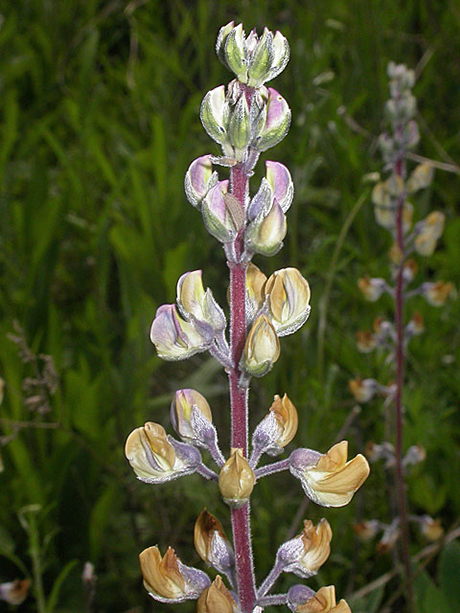
Kincaid’s lupine is a perennial arising from a branched crown, usually with numerous unbranched stems (30) 40-80 (100) cm tall, with whitish or brownish stiff to silky pubescence. Basal leaves are usually persistent until after flowering, with petioles (2) 3-5 times the length of the blades; upper cauline leaves have petioles sometimes shorter than the blades. Leaflets typically number 7-12, are narrowly oblanceolate, usually somewhat acute, 2.5-5 cm long, often remaining somewhat folded, and usually glabrous above and sparsely to copiously hairy beneath. Inflorescences are slender, the flowers numerous and arranged in interrupted whorls. Flowers are fragrant and range in color from bluish or purple to yellowish or creamy white, quickly turning orangebrown with age. The banner is distinctively ruffled (markedly concave on the lateral faces), glabrous, and only somewhat reflexed from the glabrous keel. Pods are 3-4 cm long, with 1-6 pinkish-brown to black seeds.
Overview
- Species Common Name Kincaid's lupine
- Species Scientific Name Lupinus oreganus
- Federal Listing Status Threatened
- State Listing Status Threatened
Ecoregions
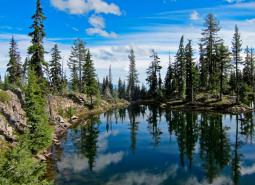
Klamath Mountains
The Klamath Mountains ecoregion covers much of southwestern Oregon, including the Klamath Mountains, Siskiyou Mountains, the interior valleys and foothills between these and the Cascade Range, and the Rogue and Umpqua river valleys. Several popular and scenic rivers run through the ecoregion, including the Umpqua, Rogue, Illinois, and Applegate rivers. Historically, this ecoregion is known …
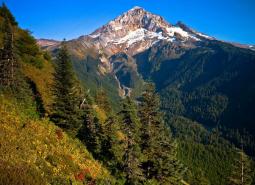
West Cascades
The West Cascades ecoregion extends from east of the Cascade Mountains summit to the foothills of the Willamette, Umpqua, and Rogue Valleys, and spans the entire length of the state of Oregon. It is largely dominated by conifer forests, moving into alpine parklands and dwarf shrubs at higher elevations.
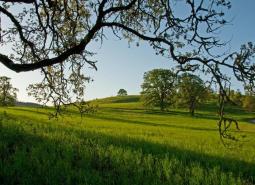
Willamette Valley
The Willamette Valley ecoregion is bounded on the west by the Coast Range and on the east by the Cascade Range. This long mostly level alluvial plain has some scattered areas of low basalt, and contrasts with productive farmland and large urban areas. It has the fastest-growing human population in the state resulting in challenges due to land-use changes.