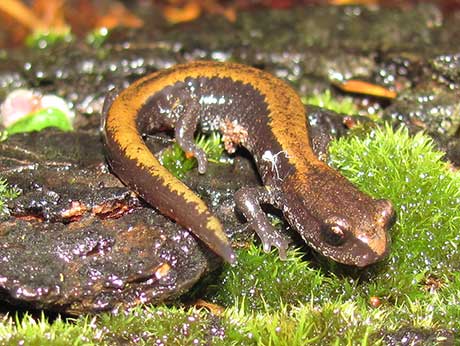
The Larch Mountain salamander is a salamander endemic to the Pacific Northwest in Oregon and Washington. It belongs to the Plethodontidae family of lungless salamanders. Larch Mountain salamanders have a fully terrestrial life cycle: young hatch from eggs in their adult form. Larch Mountain salamanders are strikingly marked with a thick, uneven-edged stripe running from the neck to the tail tip that is red, orange, or chestnut-brown in color. They are dark brown or black in ground color on their backs, with white and gold speckling on their sides. Most adults have pinkish abdomens, though the coloration of their underside can range from a white gray to bright red. Juvenile coloration differs from adults: the stripe on their back has even margins, and their underbelly is black with some red pigmentation. They have five toes on their hind feet, with a shortened outer toe. Growing to a maximum of two inches from snout to vent, they are the smallest western salamander in the Plethodon genus. Larch mountain salamanders have a restricted range, and geographic location as well as habitat are important features to consider when identifying them.
Larch Mountain salamanders are patchily distributed in the Cascade Range of Washington and in a small portion of the Columbia River Gorge in Multnomah, Hood River, and Clackamas counties in Oregon. The amount of suitable habitat modeled for this species is very limited and is largely found on U.S. Forest Service lands (Columbia River Gorge National Scenic Area and a few on Mt. Hood National Forest). They occur on rocky substrates ranging in size from well-drained gravel to smaller cobble-sized talus. This species prefers low soil content and moderate ground cover from organic materials including litter and debris. Moderate ground cover supports moist microclimates but still allows for ease of movement among rocky substrates. They are commonly associated with late-successional forests; however, they may also occupy unforested areas or young forest with appropriate overstory or ground cover and steep, rocky substrate types.
Limiting factors
This species has highly specialized habitat requirements. It has a relatively small clutch size, is highly philopatric, and has a patchy distribution with low dispersal capability–all factors which can increase vulnerability of populations to disturbances. Pesticides or fertilizers may negatively affect these salamanders and their food supply. Land management practices that reduce canopy cover or expose substates to disturbance (timber harvests, fuels management, road building, development, mining, etc.) are considered a primary threat to habitat for both the Columbia River Gorge and Cascade Mountain populations. Under future climate change scenarios, this species may be affected by altered patterns of temperature and precipitation, particularly where drought results in an increased risk of catastrophic wildfire. Volcanism is a known concern, as the May 1980 eruption of Mt. St. Helens resulted in local extirpation. Chytrid fungus (Batrachochytrium dendrobatidis or B. salamandrivorans) may present a threat to the species, but the extent of this threat is currently unknown. Development near suitable or occupied habitat could have a negative impact on the species.
Data gaps
• Assess distribution, abundance, and population trends.
• Document basic life-history information including diet, recruitment rates, survival rates and causes of mortality, dispersal, longevity, and reproductive biology.
• Determine whether habitat connectivity is a concern between occupied sites.
• Evaluate response to silviculture practices and recreational activities, including at cave sites.
• Evaluate the effects of chemicals, disease, mining, and future climate scenarios on this species.
• Revisit historical sites to determine current occupancy trends.
• Continue to evaluate new survey techniques to improve detectability.
Conservation actions
• Protect habitat integrity and avoid alteration and ground-disturbance of talus, which can cause local extinctions.
• Avoid use of pesticides adjacent to talus, and manage lands adjacent to occupied sites with species’ requirements in mind as these areas may be important dispersal or foraging areas.
• Improve habitat connectivity between breeding sites.
• Identify and prioritize protection of habitats with higher climate-resiliency.
• Consider timing of management actions to limit overlap with periods of salamander surface activity.
Key reference or plan
Conservation Assessment for the Larch Mountain Salamander (Plethodon larselli) 2008. Charles M. Crisafulli, David R. Clayton, Deanna H. Olson. ISSSSP Read here