Large-flowered goldfields is a perennial herb, often rhizomatous and clump-forming, from 2.5-30 cm tall, frequently with a dwarfed and compact growth form on windswept bluffs. The decumbent, somewhat hairy stems branch near the base and the linear to oblong leaves are 5-40 mm long, 1-5 mm wide, with entire margins and glabrous or somewhat hairy surfaces. lnvolucres bell-shaped to hemispheric, 5-14 mm tall, with 6-15 phyllaries that are pubescent and elliptic to ovate. Receptacle is conic and glabrous but roughened (muricate). The 8-15 ray florets are conspicuous, with yellow, 5-9 mm long laminae while the smaller 10-70+ disc florets are 1-3 mm long, with stamens and styles slightly exserted. Fruits are 3-4 mm long, glabrous, linear to narrowly club-shaped, with pappi of 0-4 bristle-tipped awns, clear to brown and 1-3 mm long.
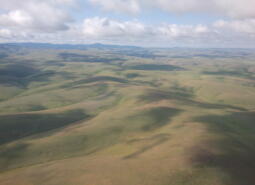
Large-flowered goldfields grows in rhizomatous mats on sandy, shore-facing cliffs, seaward slopes, and “sea terraces.” Known from grasslands along coastal bluffs with other coastal headland plants.
Limiting factors
This species is threatened by limited habitat availability and ongoing habitat loss. It is threatened by erosion from natural (wind, rain) and human (recreationalists) forces. Perennial pasture grasses and other invasive species were introduced at some sites, and encroachment of conifers and shrubs now occurs at almost all sites. Climate change also has the potential to decrease survivability of the species.
Monitor existing populations. Protect, maintain and restore existing habitat. Identify additional suitable habitat. Collect and bank seed as insurance against local extirpation or extinction and to use in ex-situ research. Conduct ex-situ seed/plug production for introduction and augmentation efforts.
Key reference or plan
Marshall, DA. 2024. 2024 listing status assessment for Lasthenia ornduffii (large-flowered goldfields). Oregon Department of Agriculture, Salem, Oregon.