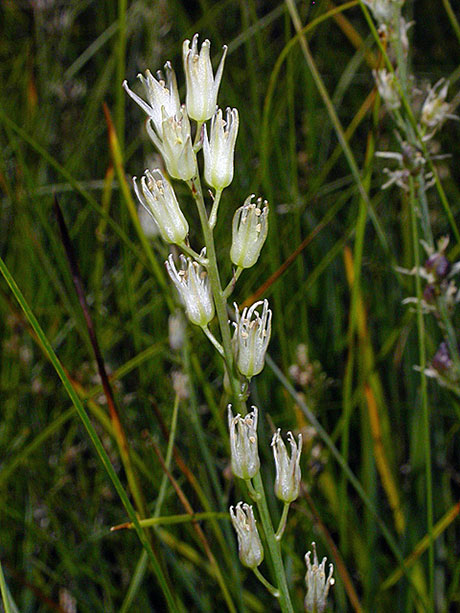
Large-flowered rush lily is a bulbous perennial with a solitary flowering stalk up to a meter in height. The bluish-green leaves are mostly basal, grass-like, 25-55 cm long, and glabrous, with only a few small cauline leaves. Dead and shriveled leaves are often present at the base of the flowering stalk. Flowers are arranged in racemes with the terminal raceme having 20-70 flowers. In branched stalks, 1-3 smaller lateral racemes are also present. The narrow, 9-12 mm sepals and petals have pointed tips, and flowers occur as one of two color forms, white (H. bracteosa var. bracteosa) or dull purple (H. bracteosa var. atropurpurea). These color forms were once considered separate species. However, more recent genetic and morphological research supports recognition of these forms as varieties; both varieties have Threatened status. Intermediate, pink-flowered forms have been reported from one site where the two varieties co-occur.
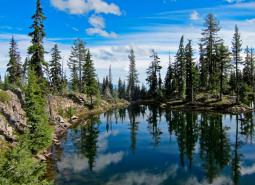
The large-flowered rush lily occurs in bogs, moist, open meadows, seeps, and wetland areas, generally at elevations of 1150-2300 feet. This species is associated with serpentine or peridotite soils. It is commonly found in open areas, with gentle slope.
Limiting factors
This species is severely impacted by cattle grazing. Mining, water diversion from serpentine wetlands, off-road vehicle use, and land development are additional threats. The large-flowered rush lily is also moderately vulnerable to climate change, particularly due to predicted alterations to hydrologic regimes.
Data gaps
Conduct germination studies. Develop propagation and transplanting protocols.
Conservation actions
Maintain California pitcher-plant bogs, which provide habitat for many rare species. Minimize water withdrawals from bog sites. Carefully manage or eliminate grazing at sites where this species occurs. Collect/store seeds, including seeds from both white and purple flowers.
Key reference or plan
A conservation agreement for Hastingsia bracteosa, Hastingsia atropurpurea, Gentiana setigera, Epilobium oreganum, and Viola primulifolia ssp. occidentalis and serpentine Darlingtonia wetlands and fens from southwestern Oregon and northwestern California was developed by U.S. Forest Service, Bureau of Land Management, and U.S. Fish and Wildlife Service in 2006. Management recommendations are included in ODA‘s 2017 report (Brown, J and RJ Meinke. 2017. Assessment of serpentine Darlingtonia wetlands and five associated rare vascular plants: Protocols and baseline monitoring in 2015-2016 and 2017. Report prepared for Medford BLM District and Rogue River-Siskiyou NF. Report preprared by Oregon Department of Agriculture, Salem, Oregon.)