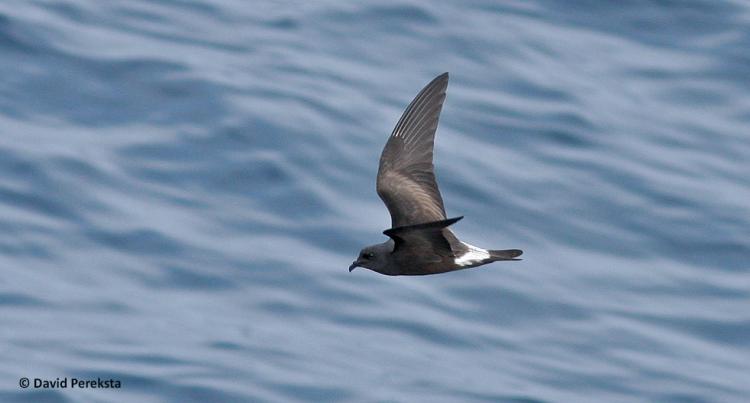
Leach’s Storm-Petrel (Hydrobates leucorhoa) is believed to be the most widespread species of its kind (procellariiform) that breeds in the Northern Hemisphere. It nests in both the Atlantic and Pacific Oceans. After the breeding season, these seabirds travel far across the open ocean, often moving into tropical waters and staying well away from land. While flying at sea, they stay close to the surface of the water. Their feet may touch the water while feeding, and their flight is often described as tern-like.
This is a medium-sized storm-petrel, measuring between 18 and 22 centimeters in length. Sexually monomorphic, with white rump patch, distinctly forked tail, and long wings angled at the wrist (carpal joint). Their plumage is dark blackish-brown, with slightly lighter gray on the upper parts. The crown, flight feathers, and tail are darker than the rest of the body. Broad diagonal paler wing-bar formed by greater secondary coverts runs from leading edge near bend of wing toward trailing edge close to body. Plumage appears unchanged throughout the year.
Leach’s Storm-Petrels nest on coastal islands and other areas inaccessible to terrestrial predators. While they are known to occupy over 20 different islands in Oregon, the overwhelming majority of individuals occupy Saddle Rock, Crook Point Rock, Hunter’s Island, Goat Island, Whaleshead Cove, and Boardman State Park. They use crevices or sites with well-developed soil and vegetation for nesting. The most important determinants of burrow site selection appears to be soil depth and compressibility. When foraging, Leach’s Storm-petrels tend to congregate at ocean fronts and eddies, where upwelling brings prey to surface waters.
Limiting factors
The availability of suitable nesting islands is an important limiting factor for Leach’s Storm-Petrels. Nest sites are vulnerable to predation by non-native predators as well as artificially abundant native predators. Changing ocean conditions can affect the quantity and quality of available prey. Adults are particularly susceptible to ingesting plastics and oil due to their surface-foraging behavior at sea. They are also vulnerable to oil-spill pollution, oil-dispersant emulsions, and contamination from organochlorine compounds, including pesticides and per- and polyfluoroalkyl substances (PFAS).
Data gaps
• Improve understanding of breeding biology specific to Oregon. Most information on Leach’s Storm-petrel reproduction comes from studies outside Oregon.
• Identify important foraging areas.
• Assess the impacts of light attraction at onshore and offshore energy facilities or other developments.
• Determine diet during nesting and evaluate zooplankton prey availability dynamics.
• Determine migration patterns and their non-breeding ocean distribution.
• Assess population status and trends. Demographic data are not available for Oregon.
Conservation actions
•Maintain existing closure of nesting areas to human visitation.
•Continue implementing mammalian predator control at Oregon seabird colonies: mammalian and avian predators have significantly affected Leach’s Storm-petrel mortality in Oregon.
• Improve census/survey methods.
•Monitor and minimize impacts from ocean and coastal energy development projects.
Key reference or plan
U.S. Fish and Wildlife Service, Regional Seabird Conservation Plan, Pacific Region. Read here