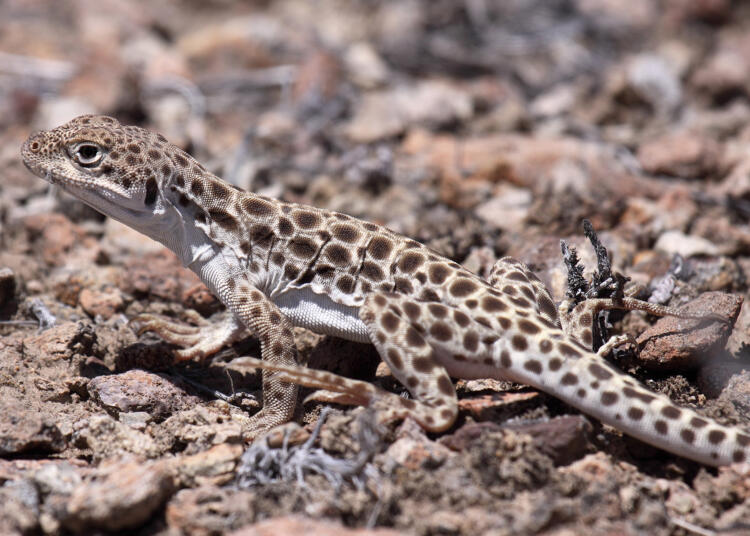
Long-nosed leopard lizards are medium sized with round bodies, grey throats and dark spots covering most of their body. Their tails are quite long, more than twice the length of their bodies. During the breeding season females have red or orange spots along their sides
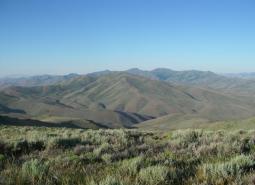
The long-nosed leopard lizard occupies flatland deserts preferring sandy, rocky areas with sparse cover from shrubs. Utilizes mammal burrows for egg-laying.
Limiting factors
Occurrence of long-nosed leopard lizard is low Oregon within its restricted range, but the species can be locally abundant in suitable habitat. Species is vulnerable to habitat loss and degradation (including by invasive species, fire, roads). Additionally, this species is particularly vulnerable to combined climate change and rarity concerns: climate change may affect food resources and associated fitness. Land use changes, including potential lithium mining within OR range, threaten the species directly and indirectly through habitat loss. OHV recreational use disturbs habitat quality and may cause direct mortality.
Data gaps
• Collect population occurrence data and trends.
• Enhance the limited information available describing the species in Oregon. Some information exists from Alvord Desert and Harney County. Additional assessments of population status, trends, and habitat use are needed.
• Determine implications of various land uses on suitable habitat.
• Identify habitats critical to persistence in Oregon.
• Evaluate effects of habitat fragmentation on gene flow and population trends.
• Resurvey historical sites to determine occupancy.
Conservation actions
• Evaluate effects of habitat fragmentation on gene flow and population trends.
• Resurvey historical sites to determine occupancy.
• Maintain and enhance habitat.
• Control invasive species.
• Investigate impacts of various land uses on suitable habitat.
• Manage for sustainable OHV use, invasive species.
Key reference or plan
Bureau of Land Management. 2022. Strategic Plan for Amphibian and Reptile Conservation. U.S. Department of the Interior, Bureau of Land Management, Division of Wildlife Conservation, Aquatics, and Environmental Protection, Lakewood, CO. Read here