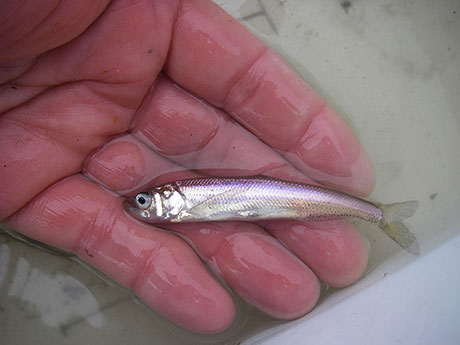
Longfin smelt are small, silver fish with long, thin bodies. They can be distinguished from other smelt species by their long pectoral fins. They are considered an anadromous species, meaning that they spawn in freshwater then move out to the ocean. However, there are landlocked populations that live entirely in freshwater lakes, such as Lake Washington. They are also frequently found in estuaries. They grow up to 6 inches long and weigh less than 1 ounce. Migration to spawning areas takes place from November through January, and peak spawning takes place sometime between December and March. There is little information on the actual spawning locations, but those that live in the ocean and estuaries are thought to enter the lower portions of freshwater streams and rivers for spawning. However, recent work in San Francisco Bay indicates that successful spawning also occurs in tidal wetlands when there is sufficient freshwater input and persistent low-salinity conditions. Females lay eggs that stick to the bottom or vegetation. Embryos are thought to hatch sometime from January to March, and development time is temperature dependent. Embryos develop more quickly in warmer temperatures, and hatching occurs after 40 days in 45°F water and in 29 days in waters between 46°F and 49°F. The newly hatched larval fish then move into low salinity estuarine waters for several months before moving downstream to more saline waters in the bays for about a year. Fish then move out to the ocean before migrating back to the spawning grounds.
Overview
- Species Common Name Longfin Smelt
- Species Scientific Name Spirinchus thaleicthys