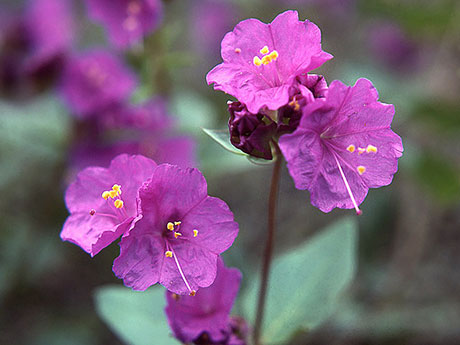
Macfarlane’s four o’clock is a stout perennial that forms hemispheric clumps 0.6-1.2 m in diameter, with several freely branched decumbent or ascending stems that are glabrous to sparsely puberulent. The leaves are opposite and fleshy, the lower blades orbicular to ovate-deltoid, the upper narrowly ovate. The petioles of lower leaves are 12.5 cm long; upper leaves are nearly sessile. Flowers are clustered (4-7) in involucres borne on stalks about 1 cm long in the upper axils and on shoot apices. The conspicuous involucres are green to purplish, 1.3-2.5 cm long. The showy perianth is magenta, broadly funnelform, and 1.5-2.5 cm long, the limb slightly longer than the tube. The ellipsoid fruits are light brown to grayish, with 10 slender ribs visible when wet, 6-9 mm long, tuberculate, glabrous or very sparsely puberulent.
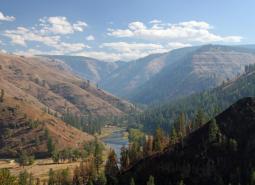
Macfarlane’s four o’clock occurs on warm, dry, open canyon slopes. Soils are sandy or rocky and often unstable.
Limiting factors
This species has a narrow distribution. The expansion of invasive plants is believed to be a primary limiting factor and increases wildfire potential. Off-highway vehicle use, construction and maintenance of roads and trails, mining, and herbicide drift are additional threats. Uncontrolled livestock grazing degrades habitat and is a large threat to this species across its range. Inbreeding depression may be a limiting factor for Macfarlane’s four o’clock. The species is moderately vulnerable to climate change, particularly because of predicted increased variability in precipitation.
Data gaps
Develop seed germination, propagation, and transplanting protocols. Conduct pollination studies. Investigate the extent of the seed bank. Determine whether inbreeding depression affects Macfarlane’s four o’clock. Assess genetic diversity across populations. Determine optimal monitoring methodology.
Conservation actions
Take site-specific actions identified in ODA‘s 2025 Habitat Management Plan, such as conducting comprehensive monitoring, collecting and storing seeds, reducing invasive species cover, and enhancing native perennial grass cover and forb diversity. Consider introducing the species outside of the historic range of the species to more favorable climatic conditions.
Key reference or plan
A U.S. Fish and Wildlife Service Revised Recovery Plan (https://ecos.fws.gov/docs/recovery_plan/000630.pdf) was released for Macfarlane’s four o’clock in 2000. A U.S. Fish and Wildlife Service 5-Year Review addressing updated conservation needs for Macfarlane’s four o’clock was released in 2022 (https://ecosphere-documents-production-public.s3.amazonaws.com/sams/public_docs/species_nonpublish/3946.pdf). In 2025, the Oregon Department of Agriculture published a Habitat Management Plan that includes all Oregon populations (Sandlin, I. 2024. Habitat Management Plan for MacFarlane’s four-o’clock (Mirabilis macfarlanei). Report prepared for the Idaho Fish and Wildlife Office of the US Fish and Wildlife Service, Boise, ID. Oregon Department of Agriculture, Salem, Oregon.)