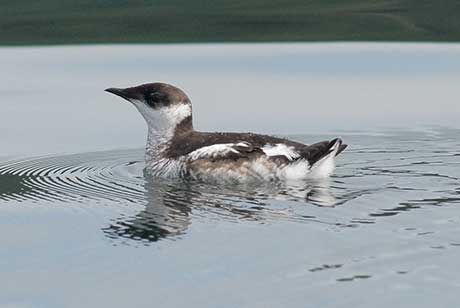
The Marbled Murrelet is a small seabird found along the Pacific coast. Adults are about 24–25 cm long and weigh between 188 and 269 grams. Although they spend most of their lives at sea, they fly inland to nest—mainly in mature, and old-growth, late- successional, or older coniferous trees. The Marbled Murrelet has a unique life history because it uses both inland forests and the ocean during its life. It nests in inland forests, and forages, loafs, courts, molts, and preens out in the ocean.
Adults are similar in both size and appearance (sexually monomorphic) but have distinct breeding and winter plumages. In breeding plumage, the Marbled Murrelet has sooty-brown upperparts with rusty-brown margins. The underparts are light mottled brown, often with rufous-brown flecking. The head and front part of the body have white feathers edged with black. The flanks are almost entirely dark brown. This cryptic coloration is believed to help them stay camouflaged from predators while nesting in the forest.
In winter plumage, the bird is dark above and light below. Fledglings appear like adults in winter plumage, with subtle differences. Newly-hatched chicks are covered with yellowish, speckled down.
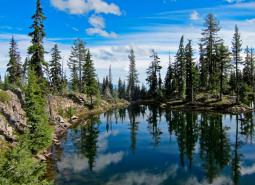
Marbled Murrelets spend the majority of time in the marine environment, in nearshore waters along exposed coastlines throughout their range. Marbled Murrelets use older, late-successional, and old-growth forests almost exclusively for nesting. In Oregon, some nests have also been found in mature and younger trees (66-150 years) containing older forest characteristics, such as platforms created by mistletoe infections or other deformities. Murrelets do not construct a nest, instead using natural nesting platforms in forested habitats. The presence of potential nest platforms provided by large or deformed tree branches with moss or lichen suitable to form a nest cup is a particularly important habitat feature. Important nesting platform characteristics exist at both branch-scale (platform size, moss cover, horizontal cover) and tree-scale (moss depth, and platform counts). At a slightly larger patch-scale, uniform stands with many marginal platform trees may be less desirable than canopy variation with a few larger trees.
Limiting factors
Marbled Murrelets are threatened by the reduction and modification of late-successional and mature forests, as well as ongoing habitat fragmentation. Low reproductive output and low nesting success further limit population growth. Predation by corvids is the leading cause of nest failure. Severe wildfire, particularly in the Klamath Mountains ecoregion, has contributed to habitat loss. Breeding success is closely tied to ocean conditions and prey availability; birds may forego breeding in years with insufficient food resources due to current upwelling. Remaining habitat in Oregon is highly fragmented, with a high proportion of edge habitat. These edge effects can increase predation risk, elevate windthrow damage, and alter microclimates, reducing nest site suitability. Ocean conditions and prey availability are key limiting factors for both breeding success and adult survival.
Data gaps
• Evaluate protected forested nesting areas effectiveness in species’ recovery; identify gaps and shortfalls.
• Assess how predator populations, habitat parameters and human uses impact populations.
• Investigate the role of isolation and/or fragmentation of nesting habitat with levels of nest predation.
• Study minimum area requirements.
Conservation actions
•Continue marine (at-sea) surveys to detect population changes in Oregon.
•Continue inland surveys to detect presence and identify nesting locations.
•Monitor impacts to nesting success to ensure breeding success and habitat stability.
•Advocate for ocean energy development projects to monitor and minimize impacts on murrelet populations.
•Lower predation rates by minimizing garbage at campgrounds near murrelet habitat following the ‘Crumb Clean’ initiative.
Key reference or plan
Biological Assessment of the Marbled Murrelet (Brachyramphus marmoratus) in Oregon and Evaluation of Criteria to Reclassify the Species from Threatened to Endangered under the Oregon Endangered Species Act. Endangered Species Management Plans Oregon ESA, 2021. Read here
Regional Ecosystem Office (REO) – Northwest Forest Plan Interagency Regional Monitoring: Marbled Murrelet Monitoring. Read here
Northwest Forest Plan – Marbled Murrelet Monitoring. Read here
Marbled Murrelet Survival Guidelines for Marbled Murrelet (OESA) OAR 635-100-0137. Read here