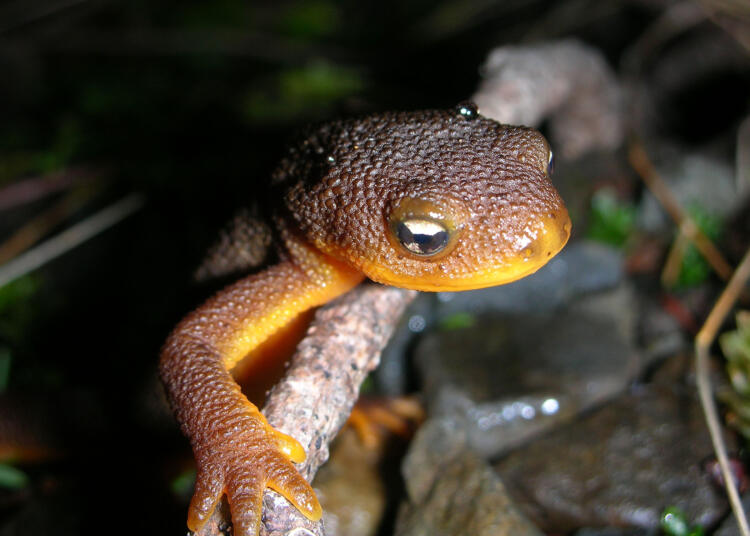
The Crater Lake newt is a distinct population of rough-skinned newt which is endemic to Crater Lake in Oregon’s southern Cascade Range. It is considered by some authorities to be a subspecies of rough-skinned newt, and was first formally described in the 1940’s. Crater Lake newts are characterized by a roughened skin surface and relatively dark ventral pigmentation. Its ventral surface is orange-yellow in coloration with dark pigmentation creating a mottled appearance. Comparisons of rough-skinned newts from across the range of the species confirms that newts in Crater Lake are distinct in morphology, physiology, and genetic makeup from populations of newts found outside of Crater Lake. The darker ventral coloring is what most clearly distinguishes this subspecies from T. granulosa.
The Mazama (Crater Lake) newt is an endemic subspecies found exclusively within Crater Lake, Oregon. They inhabit the lake’s clear, cold waters and adjacent rocky shorelines.
Limiting factors
The newt was once abundant in Crater Lake, the only place it lives, but its numbers and distribution have declined substantially with the expansion of signal crayfish (Pacifastacus leniusculus), which were introduced in 1915. Crayfish distribution within the lake has increased significantly since survey work began in 2008, and newts have been extirpated or are declining significantly in crayfish-occupied areas. Direct predation, competition, and reduced fitness due to displacement are associated with these newt declines.
Data gaps
• Identify additional limiting factors.
• Clarify taxonomy.
• Evaluate feasibility of crayfish removal strategies.
• Determine feasibility of captive breeding and rearing.
• Evaluate vulnerability to disease and climate change.
• Evaluate genetic diversity and estimate effective population size.
Conservation actions
• Continue efforts to monitor distribution and population trends.
• Implement conservation actions to help maintain or expand current newt distribution.
• Maintain or restore aquatic habitat conditions.
• Implement management actions to reduce the impacts of introduced fish and crayfish predators.
• Manage for impacts of recreation on aquatic habitats.
• Implement surveillance and treatment programs for new aquatic invasive species.
• Work with partners to assess feasibility of establishing a captive breeding program.
• Maintain or enhance regulatory protections.
Key reference or plan
Petition to list Crater Lake Newt as an Endangered Species under the ESA Read here
Buktenica, M. W., S. F. Girdner, A. M. Ray, D. K. Hering, and J. Umek. 2015. The impact of introduced crayfish on a unique population of salamander in Crater Lake, Oregon. Park Science 32(1):5–12 Read here
National Park Service (NPS), U.S. Department of the Interior. 2021. Crater Lake Longterm Limnological Monitoring Program State of the Lake Report: 2020 Read here
United States Geological Survey. 2023. Models examine how climate change may affect Oregon’s Crater Lake Read here
Replacement of a unique population of newts (Taricha granulosa mazamae) by introduced signal crayfish (Pacifastacus leniusculus) in Crater Lake, Oregon Read here