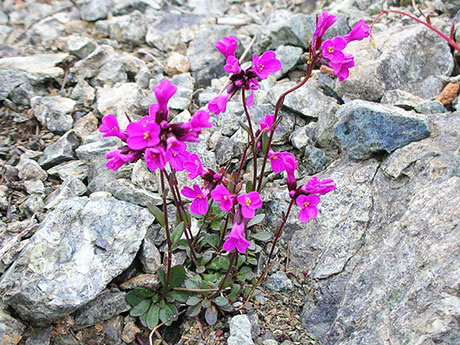
McDonald’s rockcress is a mat-forming perennial species usually with several simple stems 5-30 cm high growing from a branched caudex. Basal leaves are arranged in rosettes, are spatulate with an essentially glabrous surface, usually 1-2 cm (-3) long and 0.3-0.7 cm wide, with slightly to strongly repand or toothed margins, teeth sometimes bristle-tipped. Cauline leaves are reduced, spatulate to narrowly oblong, obtuse, sessile, and appressed, 0.3-1.0 cm long, with entire or obtuse-toothed margins. Fragrant flowers are arranged in a simple raceme and borne on pedicels 0.81.0 cm long. Sepals are greenish or dark purple, 0.4-0.8 cm long. Petals are crimson to purple in color, oblanceolate with an obtuse apex, 0.8-1.6 cm long. Siliques are 2-4 cm long and erect-spreading.
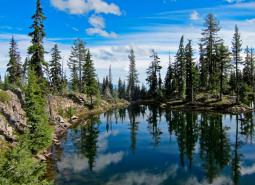
McDonald’s rockcress occurs in serpentine, fairly barren habitat, usually on steep, unstable slopes or dry, open woods. These sites are often recently disturbed and below 5900 feet in elevation.
Limiting factors
Threats to McDonald’s rockcress include slope erosion, road maintenance, logging, nickel-mining, over-collection, and off-road vehicle use. Vegetation succession may also render habitat unsuitable over time.
Data gaps
Develop propagation and transplanting protocols. Identify environmental variables associated with plant presence. Research the effect of fire on site quality and plants response to fire.
Conservation actions
Conduct surveys to locate new populations. Collect and bank seeds from Oregon populations. Minimize disturbance at priority sites during the growing season. Monitor known populations.
Key reference or plan
U.S. Fish and Wildlife Service (USFWS). 1984. McDonald’s Rock-Cress Recovery Plan (Arabis mcdonaldiana Eastwood). U.S. Fish and Wildlife Service, Portland, Oregon. [https://ecos.fws.gov/docs/recovery_plan/840228.pdf] Draft recovery plan amendment: https://ecos.fws.gov/docs/recovery_plan/DRAFT%20Recovery%20Plan%20Amendment%20MCRC.pdf