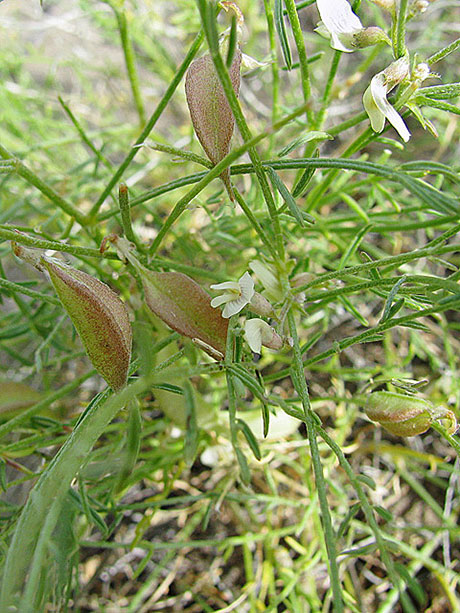
Mulford’s milkvetch is a perennial species with a long taproot and clustered, slender, wiry, thinly strigose stems, 3–20 cm long, arising from a woody, many-branched caudex. Leaves are 4–10 cm long including the petiole, with a flattened rachis and 1123 linear to elliptic leaflets, 0.3–0.8 cm long and nearly glabrous. Flowers are scattered, 5–20, in loose racemes on peduncles 5–8 cm long. The calyx is 0.28-0.5 cm long, strigose, with narrow triangular-subulate teeth slightly shorter than the tube. The corolla is whitish, drying yellow, the banner often bluish to purple lined or tinged, 0.50.9 cm long. Pods are horizontally spreading, papery, inflated, 0.8-1.5 cm long, beaked, and almost triangular in cross-section. Valves are strigose and finely crossveined, the ventral suture straight or curved slightly, the dorsal suture strongly curved. The slender stipe is 0.2-0.3 cm long.
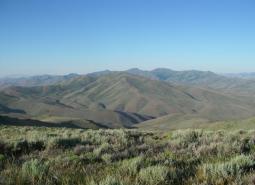
Mulford’s milkvetch is found in shrub-steppe and desert shrub communities in the semi-arid, cold-desert region of southeastern Oregon. This species occurs on moderately steep to steep southeast-, south-, and southwest-facing slopes, generally from 2200-2790 feet in elevation. Substrate may include sandy areas along rivers, old river deposits, sandy bluffs, and dune-like talus.
Limiting factors
Habitat loss due to urban development and habitat degradation have been linked to declines of Mulford’s milkvetch. Cheatgrass invasion, competition with invasive plants, herbicide drift from weed control efforts, livestock grazing and trampling, mining, off-road vehicle use, loss of pollinators due to insecticide spraying, and road development and maintenance are among the many threats to this species. Inbreeding depression is also a concern given population fragmentation and isolation. The species is moderately vulnerable to climate change, particularly because of predicted increased variability in precipitation..
Data gaps
Investigate pollination mechanisms. Evaluate genetics of different populations, as each may respond uniquely to disturbance. Develop propagation and reintroduction protocols. Improve understanding of reproductive biology. Determine long-term population trends.
Conservation actions
Continue monitoring populations. Collect and store seeds from across the species’ range. Conduct surveys to identify suitable protected habitat and establish new populations.