
Nelson’s checkermallow is an erect perennial arising from a stout taproot, the stems 40-100 cm tall and glabrous or with short, simple hairs. Leaf blades are glabrous above and sparsely covered with small, stiff hairs beneath. Basal leaves are round and palmately lobed, the lobes toothed; upper leaves are increasingly deeply cleft. The species is gynodioecious, with plants that are either pistillate (female, lacking stamens) or perfect (having both male and female parts). Racemes are somewhat spikelike, but elongate and open, bearing many flowers. Petals are pinkish lavender, calyces usually purplish tinged. Petals of perfect flowers are 9-15 mm long, the calyx 4.5-7 mm long; petals of pistillate flowers are 5-9 mm long, the calyx 4-6 mm long. Carpels are approximately 3 mm long and lightly reticulate on the sides, the beak less than 0.5 mm long.
Overview
- Species Common Name Nelson's checkermallow
- Species Scientific Name Sidalcea nelsoniana
- State Listing Status Threatened
Ecoregions
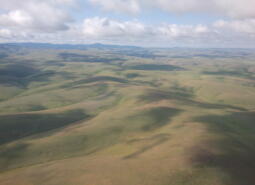
Columbia Plateau
The Columbia Plateau ecoregion was shaped by cataclysmic floods and large deposits of wind-borne silt and sand earlier in its geological history. It is dominated by a rolling landscape of arid lowlands dissected by several important rivers, and extends from the eastern slopes of the Cascades Mountains, south and east from the Columbia River to the Blue Mountains.
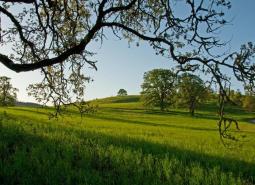
Willamette Valley
The Willamette Valley ecoregion is bounded on the west by the Coast Range and on the east by the Cascade Range. This long mostly level alluvial plain has some scattered areas of low basalt, and contrasts with productive farmland and large urban areas. It has the fastest-growing human population in the state resulting in challenges due to land-use changes.