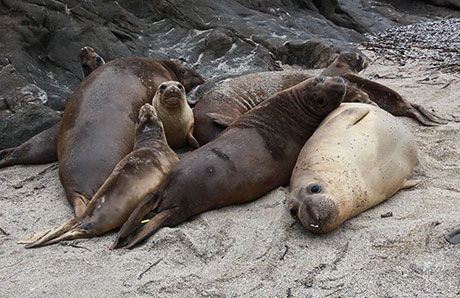
Northern elephant seals are the second largest pinniped in the world. Males are usually between 13 and 16 feet long and weigh between 3,300 and 5,100 pounds. Males develop an inflatable nose (proboscis) resembling a trunk that hangs down below their mouth. Females are smaller and are usually 10 to 13 feet in length and weigh 800 to 1,300 pounds. Northern elephant seals live about 13 to 14 years for males and 19 to 20 years for females. They spend 90 percent of their time at-sea underwater, making sequential deep dives up to 5,000 feet or more, with females making longer and deeper dives than males. When on shore, northern elephant seals, like all true seals, appear to be ungainly as they cannot use their small foreflippers or their hind flippers for “walking” like sea lions can. However, males can move very quickly on the breeding beaches when defending their territory from other males.
A small number of northern elephant seals can be seen on the sandy beaches on Shell Island or around Cape Arago State Park near Coos Bay. A much greater number come to the waters off Oregon to feed but don’t generally come ashore here. They are rarely seen at sea because they spend so little time at the surface. Northern elephant seals need to come ashore to molt when they loose not only their fur, but also an outer layer of skin in what is called a “catastrophic molt”. Northern elephant seals eat mostly fish and squid, but also will eat rays and sharks.
Limiting factors
Chemical contaminants including oil spills and plastics, and possibly entanglement in fishing gear and vessel strikes. Northern elephant seals were hunted for their blubber to make lamp oil in the 1800s and the species was considered extinct. They have undergone a genetic bottleneck and those that can be seen most frequently ashore in Oregon represent a small part of the population restricted to a small area. Breeding success resulting in survival of young from these animals appears to be rare.
Data gaps
• Factors that affect breeding success and juvenile survival for Oregon based animals.
• Amounts of plastics in their tissues and the affects they have on this species.
Conservation actions
• Avoid disturbance of animals that are ashore, especially those molting.
• Reduce potential for entanglement in fishing gear and vessel strikes.
• Reduce chemical and plastics in the marine environment.