The Northern Spotted Owl (Strix occidentalis caurina) is a medium sized, dark brown nocturnal owl with a round face, dark eyes, and no ear tufts. It has a brown facial disk with indistinct concentric circles of darker buff brown around each dark brown/black eye. Adult Northern Spotted Owls average 45 cm long. The plumage is spotted with irregular, creamy white spots on the head, neck, back, and underparts. The tail is chocolatey brown with white horizontal bars. Its mottled breast and abdomen distinguish the Spotted Owl from the larger Barred Owl (Strix varia), which has dark vertical streaking on the abdomen. The legs and feet are fully feathered. Sexes are similar in appearance, though females are larger males (females approximately 15% larger), and vocalizations differ in pitch between the sexes. The Northern Spotted Owl is the largest of three subspecies of spotted owls, and the only subspecies of Spotted Owl in Oregon. It is found in structurally complex coniferous forests in the state.
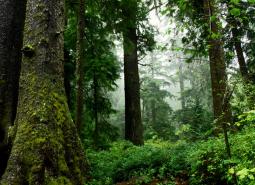
Northern Spotted Owls are year-round residents of low to mid-elevation coniferous forested habitats in western Oregon. Northern Spotted Owls nest, roost, and forage in late seral forest stands with a multi-layered, uneven-aged canopy with moderate to high canopy closure and decadence in the form of large live trees with cavities, broken tops, and dwarf mistletoe infection. These older forest characteristics provide suitable nesting structures (cavities or platforms), prey, thermal refugia, and security from predators. In western Oregon, Northern Spotted Owls occupy all low to mid-elevation coniferous forest types and will also use mixed conifer-hardwood stands, particularly in riparian corridor. On the east slope of the Cascades, they are found in mixed conifer forests of Douglas-fir, western hemlock, white fir, grand fir, ponderosa pine, and incense cedar, and occasionally in Shasta red and Pacific silver fir zones. Northern Spotted Owls require these large unfragmented areas of late-successional coniferous forest for breeding and dispersal.
Limiting factors
Northern Spotted Owls have large home range requirements. They are adversely affected by reductions in late-successional forest. Habitat loss due to uncharacteristically severe fire is of particular concern in the Klamath Mountains ecoregion. Displacement, out- competition, and potential hybridization with non-native Barred Owls (Strix varia), represent an increasing threat to the survival of Northern Spotted Owls. They are also sensitive to West Nile Virus and high pathogenic avian influenza.
Data gaps
• Assess impacts of forest operations and management.
• Evaluate continued interactions with Barred Owls and associated impacts.
• Evaluate the impacts of Barred Owl removal on Spotted Owl populations and recovery
Conservation actions
• Implement conservation actions identified within recovery plan for Northern Spotted Owl. Conservation actions are largely being pursued on federal lands in Washington, Oregon, and California through the Northwest Forest Plan, Bureau of Land Management plans, federal recovery plan, Oregon Forest Practices Act on state and private lands; and habitat conservation plans on ODF and DSL lands; and several habitat conservation plans on private forest lands.
• Reduce competition with nonnative Barred Owl
• Retain high quality habitat and protect known occupied sites
Key reference or plan
Revised Recovery Plan for the Northern Spotted Owl (Strix occidentalis caurina). Read here
Davis, Raymond J.; Lesmeister, Damon B.; Yang, Zhiqiang; Hollen, Bruce; Tuerler, Bridgette; Hobson, Jeremy; Guetterman, John; Stratton, Andrew. 2022. Northwest Forest Plan—the first 25 years (1994–2018): status and trends of northern spotted owl habitats. Gen. Tech. Rep. PNW-GTR-1003. Portland, OR: U.S. Department of Agriculture, Forest Service, Pacific Northwest Research Station. 38 p. Read here
Franklin, A.B. et al. 2021. Range-wide declines of northern spotted owl populations in the Pacific Northwest: A meta-analysis. Biological Conservation, Volume 259, July 2021, 109168, ISSN 0006-3207. Read here