The northwestern pond turtle is a mid-sized, semi-aquatic freshwater turtle and is one of Oregon’s two native turtle species. They have a smooth, broad carapace (upper shell) that is drab brown to olive in color and low in profile. The plastron (lower shell) is typically light yellow in color, sometimes with a variable number of darker blotches. The skin of the head and limbs is variable in color, typically olive-brown or yellow-brown, often with small dark dots and vermiculation. Males have a lighter colored chin and throat than females, and a longer, thicker tail than females. Adults may grow up to ten inches in length. They are usually seen basking on rocks or floating logs or vegetation in slow-moving bodies of water. Similar species in Oregon are the western painted turtle and the red-eared slider (a non-native species). All three species can sometimes be found in the same bodies of water, or even on the same log. From a distance, all three species can look similar. Red-eared sliders and western painted turtles are more vibrantly marked than northwestern pond turtles. It may be difficult to distinguish between native northwestern pond turtles and older red-eared sliders whose red markings have faded. A key characteristic to focus on is the shape of marginal scutes (plates that make up the shell); red-eared sliders have serrated marginal scutes above their tail, while northwestern pond turtles are smooth.
Overview
Species Common Name Northwestern Pond Turtle
Species Scientific NameActinemys marmorata
Federal Listing Status Species of Concern, Proposed
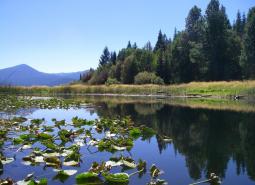
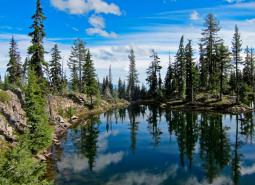
Northwestern pond turtles use permanent and seasonal aquatic habitats and terrestrial upland habitats throughout their life cycle. Generally aquatic habitat is stagnant or slow-moving waters: marshes, streams, ponds, lakes and quiet portions of rivers. They use sparsely-vegetated ground with substantial sun exposure nearby aquatic habitats for digging nests and shrubby or forested areas for aestivation and over-wintering. They require sun-exposed logs, emergent vegetation, and rocks for thermoregulatory basking in addition to safe movement corridors between aquatic and terrestrial habitat. In western Oregon, hatchlings use aquatic habitats that are within 1 m of shore with dense submerged or emergent vegetation and woody debris. Juveniles and hatchlings prefer aquatic habitats that are slow-moving and shallow, and warmer bodies of water with extensive emergent vegetation.
Limiting factors
Fragmentation, degradation, and loss of important aquatic and upland habitat are significant threats for this species. Particularly in urban or developed areas, populations are threatened by road mortality, predation by native (e.g. raccoon) or invasive species (e.g. American bullfrog, bass, or crayfish), exposure to pollutants and diseases, and potential for competition with non-native species like the red-eared slider. Low recruitment of juveniles into the breeding population is a significant limiting factor for northwestern pond turtle. Life history traits make this species particularly vulnerable to threats including climate change and associated increases in drought and wildfire risk. Some populations of this species may be at risk due to illegal collection for food or for the pet trade. Increasing recreational pressure may result in increased stress and other physiological consequences from frequent disturbance, and turtle nesting sites may be inadvertently harmed by recreational users and pets. Loss of habitat connectivity can further isolate small populations, resulting in increased risk of local extirpation.
Data gaps
• Gather basic life history information on movement, home range size, and ecology.
• Document core population areas and determine presence/absence in suitable, unsurveyed habitat within the known range.
• Continue to revisit historic sites to better understand occupancy trends.
• Describe population dynamics.
• Evaluate genetics.
• Assess the impacts of raccoons and invasive species (turtles, fish, and bullfrogs) and monitor effectiveness of removal efforts.
• Evaluate the effects of herbicides, fertilizers, and other chemicals on eggs and hatchlings.
• Improve understanding of hatchling ecology; hatchlings are difficult to observe.
• Document disease trends and vulnerabilities.
• Identify effective habitat restoration strategies.
• Test new detection methods to better understand distribution and occupancy.
Conservation actions
• Identify population centers.
• Use distribution data to establish priority areas for protection and management.
• Provide basking structures and nesting habitat.
• Protect adjacent upland habitat and dispersal corridors.
• Minimize disturbance in nesting areas and manage for sustainable recreation.
• Implement the Oregon Department of Fish and Wildlife’s Turtle Best Management Practices.
• Control invasive plants and animals.
• Prevent release of pet turtles.
• Prevent illegal collection.
• Increase outreach efforts to help prevent illegal collection and the release of pet turtles.
• Document the extent of road mortality, and take actions to reduce the risk of mortality from roads.
• Investigate movement ecology and home range size.
• Monitor for turtle shell rot disease and determine any impacts to populations.
• Implement restoration projects to improve habitat connectivity or quality, and monitor outcomes to inform and improve practices for future efforts.
• Consider impacts to northwestern pond turtle when proposing land use actions or development proposals.
• Monitor focal sites to document existing threat extent and severity or to detect arrival of new threats.
Key reference or plan
Guidance for Conserving Oregon’s Native Turtles Including Best Management Practices. Read here
Western Pond Turtle: Biology, Sampling Techniques, Inventory and Monitoring, Conservation, and Management. Ed R. Bruce Bury. 2012. Society for Northwestern Vertebrate Biology Olympia, Washington. Read here
Species Status Assessment Report for the Northwestern Pond Turtle (Actinemys marmorata) and Southwestern Pond Turtle (Actinemys pallida), Version 1.1. Read here
Conservation of the Western Pond Turtle: Range-wide Conservation Strategy and Agreement. Read here