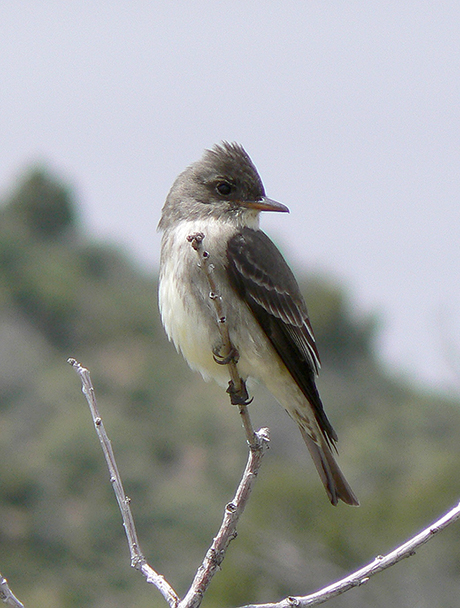
The Olive-sided Flycatcher (Contopus cooperi) is a large flycatcher species. They are grayish-brown dorsally with a large and dark head, a stout bill, a short tail, and pointed wings. These birds are grayish-brown on the back with a large, dark head, a stout bill, a short tail, and pointed wings. Their dusky-colored flanks contrast with a white breast and throat, and a whitish-yellow belly. A key field mark is the presence of white tufts on either side of the rump, which helps distinguish them from similar flycatcher species. Olive-sided Flycatchers show no sexual dimorphism—males and females look alike—and there is little difference between their basic and alternate plumages. Juveniles closely resemble adults but tend to be browner on the back, and their feather tips and wing bars have a more buff-colored tone of white. They are long-distance migrants, wintering in Mexico and Central America.
Overview
- Species Common Name Olive-sided Flycatcher
- Species Scientific Name Contopus cooperi
- Federal Listing Status Species of Concern
- State Listing Status Sensitive
Ecoregions
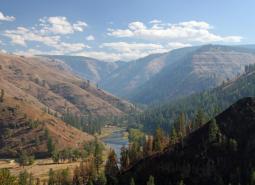
Blue Mountains
Located in NE Oregon, the Blue Mountains ecoregion is the largest ecoregion in the state. It provides a diverse complex of mountain ranges, valleys, and plateaus that extend beyond Oregon into the states of Idaho and Washington.
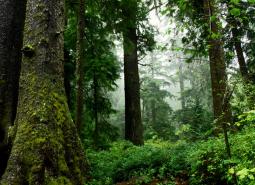
Coast Range
Oregon's Coast Range, known for its dramatic scenery, is extremely diverse, with habitats ranging from open sandy dunes to lush forests and from tidepools to headwater streams. It follows the coastline and extends east through coastal forest to the border of the Willamette Valley and Klamath Mountains ecoregions
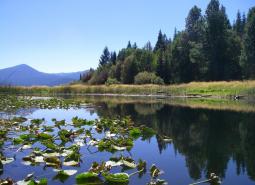
East Cascades
The East Cascade ecoregion extends from the Cascade Mountains' summit east to the warmer, drier high desert and down the length of the state. This ecoregion varies dramatically from its cool, moist border with the West Cascades ecoregion to its dry eastern border, where it meets sagebrush desert landscapes.
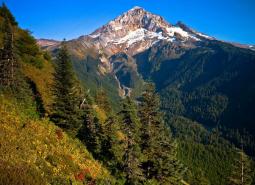
West Cascades
The West Cascades ecoregion extends from east of the Cascade Mountains summit to the foothills of the Willamette, Umpqua, and Rogue Valleys, and spans the entire length of the state of Oregon. It is largely dominated by conifer forests, moving into alpine parklands and dwarf shrubs at higher elevations.
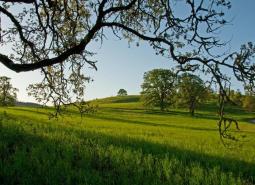
Willamette Valley
The Willamette Valley ecoregion is bounded on the west by the Coast Range and on the east by the Cascade Range. This long mostly level alluvial plain has some scattered areas of low basalt, and contrasts with productive farmland and large urban areas. It has the fastest-growing human population in the state resulting in challenges due to land-use changes.