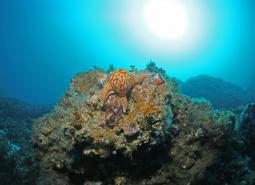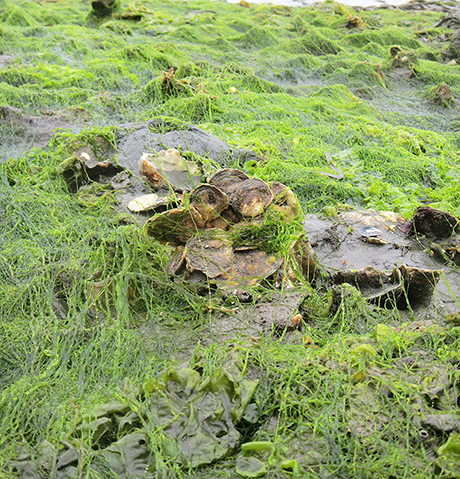
The Olympia oyster is a small (6 to 8 cm) oyster with rounded or elongated shells (valves) that can be white to light purple and sometimes marked by yellow or brown streaks. The shells of Olympia oysters lack a periostracum, which is the thin, outermost organic layer that prevents erosion of the underlying shell. Olympia oysters typically occur in protected bays and estuaries where they are attached to the undersides of rock, gravel, wood, shells, pilings and other hard substrata. Although Olympia oysters typically inhabit the intertidal and subtidal zones of estuaries where they tolerate a broad range of salinities (12 – 25 psu; occasionally lower), they have also been observed in deeper water to a depth of 71 m where salinities are expected to be similar to ambient seawater. Olympia oysters are suspension feeders that use their gills to capture suspended phytoplankton for food. Adults mature as protandric hermaphrodites that switch genders over each reproductive season. They begin their first spawning period as males that switch to female for subsequent reproductive events. Males release spermatozoa from their mantle cavity in the form of sperm balls, and females brood their embryos and early larvae internally (brood size about 250,000 – 300,000 embryos) before releasing them into the water column. The free-swimming veliger and pediveliger larvae remain in the water column for about 11 to 16 days, where they are dispersed by tidal current before settlement and attachment to hard substrata on the bottom. Adult and sub-adult Olympia oysters are preyed upon by several species of crab (Dungeness crab, red rock crab, European green crab), sea stars, predatory snails (oyster drills), and birds (scaup, scoters, diving ducks, oystercatchers). Olympia oysters were historically abundant in a few Oregon estuaries (Netarts Bay, Yaquina Bay, Coos Bay) where they were the target for a wild-stock fishery. However, the populations in Oregon have decreased to a small fraction of their historic numbers due to overharvests and habitat loss. The biogeographic range is typically reported to extend from Sitka (AK) to Baja California (MX).
Overview
- Species Common Name Olympia oyster
- Species Scientific Name Ostrea lurida