Photo Credit: Peter Pearsall, U.S. Fish and Wildlife Service
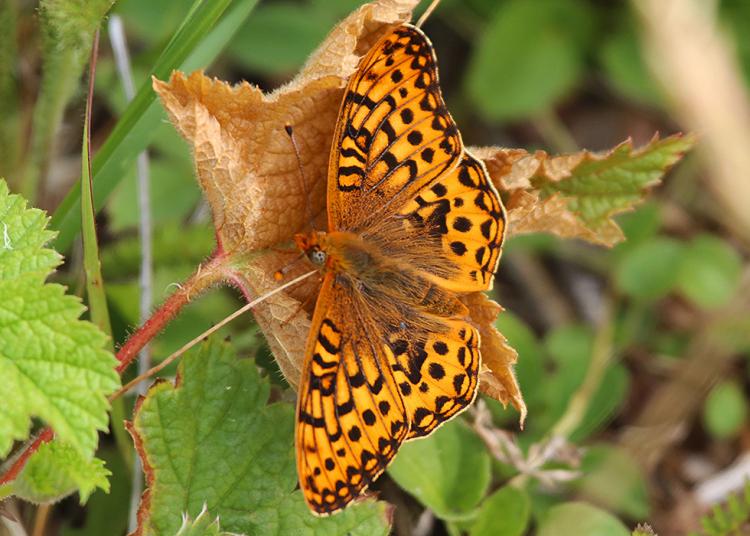
Oregon silverspot butterfly belong to a subfamily of medium and large sized butterflies with distinctive black line and dot patterning on bright orange dorsally, and a heavily-patterned ventrum. Males have a forewing length of 24 to 29 mm. The color on the dorsal wings is medium to reddish orange with heavy dark basal suffusion. The ventral hindwing has a dark reddish brown disc and a narrow yellow submarginal band. The ventral hindwing also has small, metallic silver spots in discal, median, and submarginal areas of the wing.
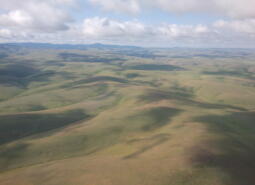
Oregon silverspot butterflies occur in salt-spray meadows, stabilized dunes, and montane grasslands. They depend upon a high density of violets (early blue and western blue violets) as host plants. Stands of early blue violets sufficient to provide enough food for Oregon silverspot butterfly caterpillars occur only in relatively open and low growing grasslands. Plants that provide nectar to adult butterflies include, but are not limited to, yarrow (Achillea millefolium), pearly everlasting (Anaphalis margaritacea), Pacific aster (Symphyotrichum chilensis), Canada goldenrod (Solidago canadensis), tansy ragwort (Senecio jacobaeae), and edible thistle (Cirsium edule).
Limiting factors
Habitat loss due to coastal development is a major limiting factor for Oregon silverspot butterflies. Sufficient violet and/or native nectar plant abundance and/or density is lacking at most sites. The invasion and dominance of nonnative plants and the disruption of natural disturbance regimes, which historically maintained coastal prairie ecosystems, continues to threaten the survival of the species by degrading habitat quality. Recreation and other activities that disturb or modify grassland habitat can be harmful to this species. In the long-term, climate change is likely to indirectly affect Oregon silverspot butterfly by altering biotic and abiotic conditions, leading to declines in suitable habitat and altering food and nectar plant phenology. Sea-level rise may render current habitat in low-lying areas unsuitable.
Data gaps
Develop management techniques for violet host plants. Determine effective management treatments and strategies to increase habitat quality. Monitor success of reintroductions throughout the species’ range. Describe population genetics and research metapopulation dynamics. Research causes of continued population declines.
Conservation actions
Continue to implement actions identified in the recovery plan. Protect known sites of occurrence, with long-term monitoring and management to maintain suitable habitat characteristics. Manage habitat to provide sufficient numbers of violets and nectar plants. Implement established strategies to restore prairie habitat. Develop comprehensive management plans for occupied sites. Continue to augment all populations. Continue annual index counts to monitor population levels.
Key reference or plan
U.S. Fish and Wildlife Service. 2020. Oregon silverspot butterfly (Speyeria zerene hippolyta) 5-year Review. U.S. Fish and Wildlife Service, Portland, Oregon. 41 pp.
U.S. Fish and Wildlife Service. 2001. Revised recovery plan for the Oregon Silverspot butterfly (Speyeria zerene hipployta). USFWS Region 1. Portland, Oregon. 111 pp.